
Why Did My Dental Implant Screw Fall Out?
A dental implant screw falls out when the abutment screw holding your crown to the implant works loose under chewing forces. The implant body in your jawbone is almost never the part that has come out. Keep the piece and call the clinic.
It feels alarming, a piece of your tooth in your hand. In most cases it is a mechanical hiccup with a quick mechanical fix.
Which Part of the Implant Has Fallen Out?
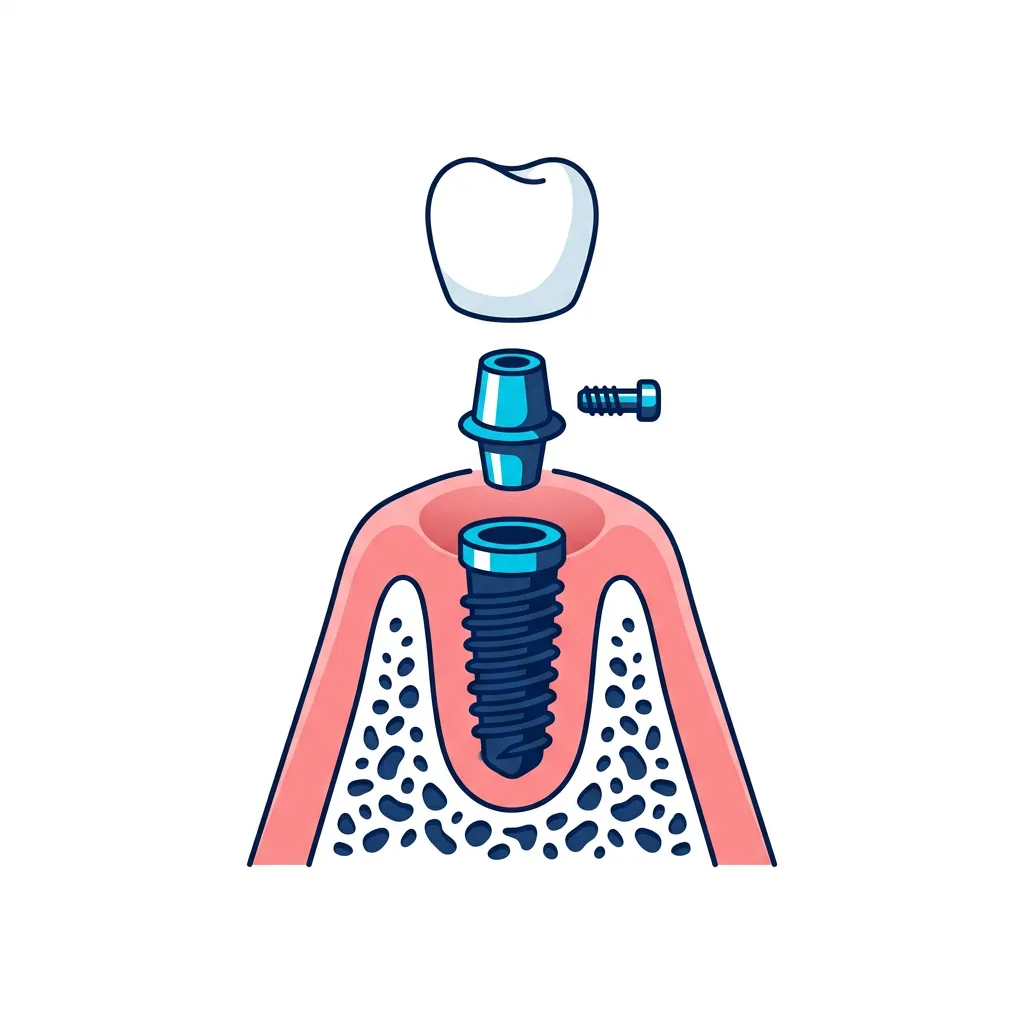
An implant tooth has four parts, and identifying the one you are holding tells you how serious this is. Match your piece against this table before you panic:
| Part | What it looks like | What it means |
|---|---|---|
| Healing cap | A small dome-topped metal disc, lost during the healing months | Common and minor, but refit it soon or the gum starts closing over the implant |
| Abutment screw | A tiny screw a few millimetres long, sometimes still inside the crown | The classic "screw fell out". The implant is fine; the crown needs refitting |
| Crown | The tooth-shaped piece, with or without a screw attached | Either its screw loosened or its cement gave way. Keep it; it can often be refitted |
| Implant body | A dark titanium cylinder with spiral threads, like a tiny rawlplug | Rare, and it means the implant itself has failed. See a dentist urgently |
The overwhelming majority of "my implant screw fell out" cases are the second and third rows. The fourth is the only one that counts as a failure.
Identified your piece and want the why?
Why Do Implant Screws Work Loose?
Implant screws work loose through thousands of chewing cycles, each one delivering a tiny vibration to the joint between crown and implant. Over years, that vibration can gradually unwind a screw. Several things speed the process up:
- A screw not tightened to the manufacturer's torque setting when the crown was fitted.
- Grinding or clenching, which multiplies the daily force count enormously.
- A bite that strikes the implant crown too hard or at an angle.
- A crown that never sat perfectly, leaving the screw to absorb movement.
- A worn or reused screw carrying old fatigue.
Prevention is unglamorous: implants placed and torqued correctly in the first place, with the bite checked at fitting and again at reviews. Implant screws have precise torque settings for a reason, and a torque wrench is standard equipment in a serious clinic.
So what do you do with it?
What Should You Do Right Now?
Five steps, in order, starting the moment you find the piece:
- Keep it. Rinse it clean and store it in a small pot. The clinic can identify the part, and often the implant brand, from that one component.
- Do not try to screw anything back in yourself. Cross-threading the internal channel turns a ten-minute fix into a genuine problem.
- Chew on the other side and keep the area clean with gentle brushing.
- Photograph the piece and the gap, and send both to the treating clinic.
- Call within days, not weeks. An open screw channel collects debris, gum can start to grow over the implant head, and neighbouring teeth begin to drift into the space.
Wondering what the fix looks like?
What Does Refitting Involve?
Refitting is usually one short appointment. The dentist identifies the part, cleans the screw channel, fits a new screw where needed, tightens it to the manufacturer's torque setting and checks your bite, with an X-ray if anything looks doubtful.
A screw that has worked loose is often swapped for a fresh one rather than reused, because screws stretch slightly in service. If the crown came away with cement residue rather than a screw, it is cleaned and re-cemented after the same checks. If your treatment carries a guarantee, ask the treating clinic whether the refit is covered before paying anyone; loose components within the guarantee period usually are.
When Is a Lost Screw a Sign of a Bigger Problem?
A screw that loosens once is maintenance. A screw that loosens repeatedly is a message, usually about an overloaded bite, a worn component or a crown that has never seated properly, and it needs diagnosing rather than retightening for the third time.
Watch for company it keeps. Soreness, swelling or bleeding alongside the loose part belongs in the same conversation as implant pain that appears years later, where infection around the implant becomes the concern. And any movement of the implant body itself, the part in the bone, is failure rather than loosening, and needs an urgent appointment wherever you were treated.
Frequently Asked Questions
-
Can I glue my implant crown or screw back in myself?
No. Household adhesives are not safe in the mouth, they block the clinic from refitting the part properly, and a badly positioned crown can damage the implant beneath it. Keep the piece clean and dry, and let the clinic refit it with the correct torque.
-
Is a fallen-out implant screw an emergency?
It is urgent rather than an emergency: a matter of days, not hours. Book promptly so the channel stays clean and nothing drifts. It becomes a same-day matter if there is pain, swelling, bleeding, or any movement in the implant itself.
-
Does a fallen-out screw mean my implant has failed?
Almost never. A loose abutment screw is a mechanical event, and the implant fused in your bone is usually untouched by it. Failure means the implant body itself is loose or coming out. That distinction is exactly what the dentist confirms at the refit appointment.
-
Will the screw fall out again?
Not usually, once it has been replaced and torqued correctly and the bite has been checked. Repeated loosening changes the question, and the dentist should then look at your bite, grinding habits and the fit of the crown rather than simply tightening it again.