
Is It Safe to Have Dental Implants in Turkey?
Dental implants in Turkey are safe when a licensed surgeon places a recognised implant brand after proper 3D planning, and risky when a clinic compresses the timeline to fit a short holiday. The variables are planning, healing time and follow-up, not the surgery itself.
That answer will not surprise anyone who has researched this properly. The surgical procedure in Antalya is the same procedure carried out in Manchester, often using the same implant systems. What varies, sometimes wildly, is everything around it.
Is Implant Surgery in Turkey the Same Procedure as in the UK?
Implant surgery in Turkey follows the same clinical protocol as the UK: a titanium implant is placed into the jawbone under local anaesthetic, left to fuse with the bone, then restored with an abutment and a crown. The protocol belongs to the implant system, not the country.
The major implant brands are international. Straumann, Nobel Biocare and Osstem implants are placed in Turkish clinics and UK practices alike, made in the same factories, shipped with the same components. A reputable Turkish clinic will tell you the brand before you book and give you the implant's serial card, sometimes called an implant passport, afterwards.
What actually differs between the two countries is the cost of chair time, laboratory work and staffing. That is where the price gap comes from. The implant in the sterile packet does not know which country it is in.
What Do Implant Survival Rates Actually Show?
Dental implants survive long term in the large majority of patients. A systematic review in the International Journal of Oral and Maxillofacial Surgery [1] followed 7,711 implants across 23 studies, with a mean follow-up of 13.4 years, and found a cumulative survival rate of 94.6%.
Read that carefully. It means implants are one of the most reliable treatments in dentistry, and it also means a small minority fail even in well-run studies. The failures tend to share the same ingredients: rushed planning, untreated gum disease, smoking, and poor maintenance afterwards.
None of those ingredients is a country. All of them are things you can screen for when choosing a clinic, in Turkey or anywhere else.
What does the safe version rest on?
What Makes Dental Implants in Turkey Safe?
Safe implant treatment in Turkey rests on the same six foundations as safe implant treatment anywhere. Before you pay a deposit, you should be able to tick every one of these:
- A named, licensed dentist or surgeon carrying out the placement, not an anonymous "implant team".
- A CBCT scan, which is a 3D X-ray of your jaw, taken and reviewed before any surgery is agreed.
- A recognised implant brand, stated in writing, with a serial card given to you after placement.
- A medical history review covering healing risks such as smoking, diabetes and medication.
- A realistic timeline with a proper healing gap between placement and the final teeth.
- A written guarantee and a named contact you can reach from the UK.
This is the standard we hold ourselves to for dental implants at our Turkey clinic, and it is the standard you should demand from any clinic that quotes you, including ours. A clinic that meets all six is not a gamble. It is simply a dental clinic.
What Makes Dental Implants in Turkey Risky?
Implants in Turkey become risky when the business model, not the dentistry, sets the treatment plan. The warning signs are consistent and easy to spot once you know them:
- A quote produced from photos alone, before any scan or examination.
- A package price that assumes extractions and implants before anyone has assessed whether your teeth can be saved.
- Permanent teeth promised within days of placement, for everyone, regardless of bone quality.
- No implant brand named anywhere in the paperwork.
- No aftercare pathway once you land back in the UK.
- Pressure to book flights before you have seen a treatment plan.
These patterns sit behind most of the horror stories, and they are the same patterns we describe in our honest account of how dental work in Turkey goes wrong. The failures are rarely mysterious. They are usually predictable from the first email.
Still tempted to squeeze it into one trip?
Why Does the Implant Timeline Matter So Much?
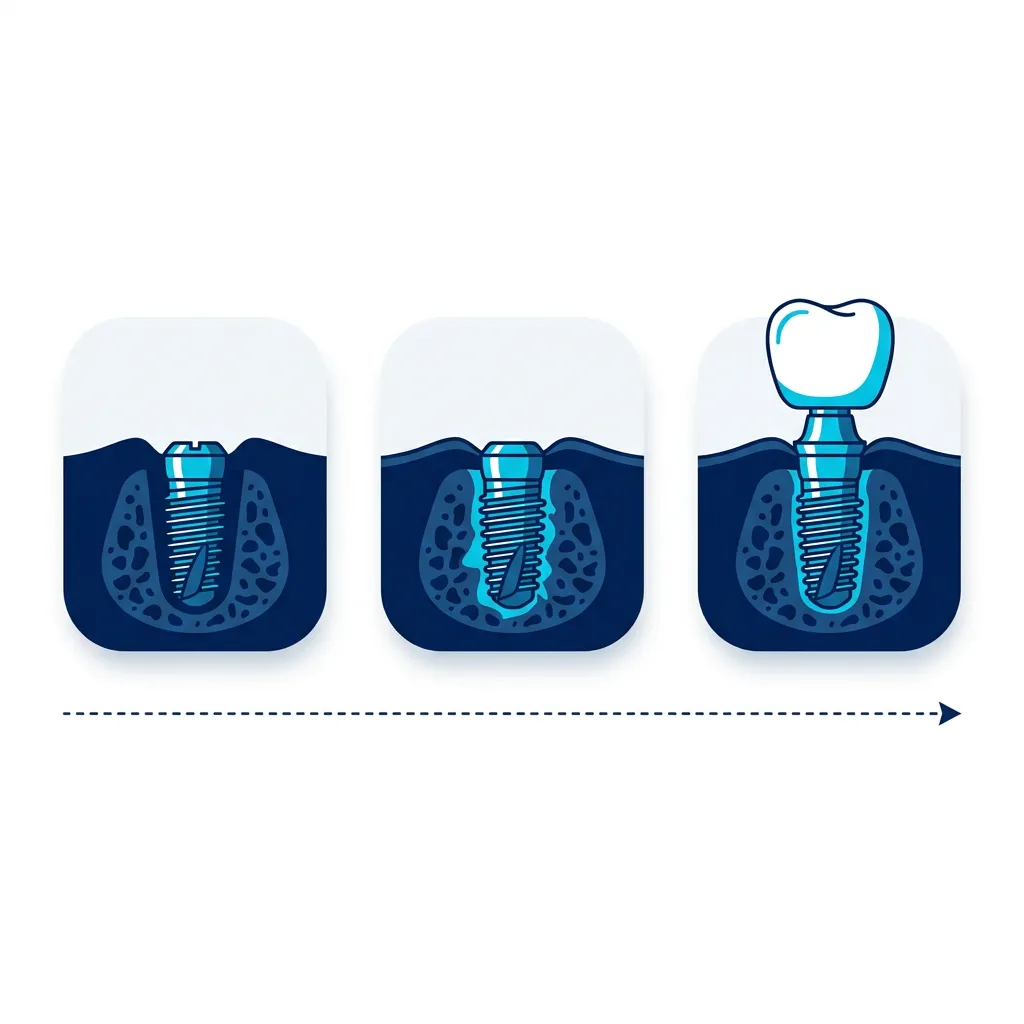
The implant timeline matters because bone fusion, called osseointegration, takes around 3 to 4 months and cannot be hurried by any clinic in any country. During that window, bone cells grow onto the implant's titanium surface and lock it in place.
Load an implant with a permanent tooth too early and it can move microscopically with every bite. The bone then heals as soft scar-like tissue instead of solid bone, and the implant loosens. That is the failure nobody sees coming, because everything looked fine at the airport.
There are genuine exceptions. Where an implant grips the bone firmly at placement, a temporary tooth can sometimes be fitted the same day, and full-arch protocols such as All-on-4 full-arch implants connect four implants with a rigid temporary bridge that spreads every chewing force across all of them.
Those are engineered exceptions with strict entry criteria, not a shortcut anyone can buy. We cover whether same-day implants in Turkey are realistic separately, because the marketing around them deserves its own post.
How Should Safe Implant Treatment in Turkey Be Structured?
Safe implant treatment in Turkey runs across two visits with a healing gap at home in between. As a guide, the structure looks like this:
| Stage | Time | What happens |
|---|---|---|
| First visit to Antalya | 3 to 5 days | Examination, CBCT scan, blood pressure and medical checks, extractions if genuinely needed, implant placement, temporary solution, aftercare briefing |
| Healing at home | Around 12 to 16 weeks | Osseointegration, remote check-ins with the clinic, normal work and eating within days |
| Second visit to Antalya | 5 to 7 days | Healing check, impressions or digital scan, final crown or bridge fitted, bite adjusted, guarantee paperwork completed |
The gap in the middle is not dead time or an inconvenience to engineer away. It is the part of the treatment that protects your money. A clinic that respects it is telling you something about how it handles everything else.
How Does Follow-Up Work When Your Clinic Is 2,000 Miles Away?
Follow-up for implants placed in Turkey runs remotely between visits, then in person at each trip. A properly organised clinic schedules photo and video check-ins through the healing months, reviews any swelling or discomfort the same day you report it, and tells you plainly when something needs a dentist's chair rather than a camera.
Distance is a real limitation, and pretending otherwise helps nobody. What closes the gap is structure: written aftercare instructions before you fly, a named contact who answers within hours, and a clinic that encourages you to keep seeing a UK dentist for hygiene visits in between. Those UK records also support your guarantee if anything is ever disputed.
The risky version is the clinic whose WhatsApp goes quiet the week after your balance clears. You can test this before booking: send a question at 8pm on a Tuesday and time the reply.
Ready to put a clinic on the spot?
Which Questions Separate a Safe Clinic From a Risky One?
Six questions expose most of the risk before you spend a penny. Ask them by email, and keep the answers:
- Which implant brand will you use, and will I receive the serial card?
- Who places the implant, and what are their qualifications?
- Will I have a CBCT scan before the treatment plan is final?
- How many weeks between placement and my permanent teeth?
- What exactly happens if the implant fails, in writing?
- Who do I contact from the UK, and how fast do they respond?
A safe clinic answers all six quickly and specifically. A risky one answers with a price.
Where This Fits in Your Implant Research
Safety before treatment is only half the question. The other half is what happens if something goes wrong afterwards, which is why it is worth understanding who is responsible if an implant fails: the difference between early and late failure, what written guarantees actually cover, and the smoking and maintenance conditions that can void them.
Licensing sits underneath everything on this page. Our guide to the accreditations to look for in a Turkish clinic explains Ministry of Health licensing, Turkish Dental Association membership and international marks such as JCI, and shows you how to verify each certificate yourself rather than trusting a badge on a website.
Frequently Asked Questions
-
Are the implant brands used in Turkey the same as in the UK?
The established brands, including Straumann, Nobel Biocare and Osstem, are used in both countries and supplied through the same manufacturers. The risk is not Turkish brands as a category; it is any clinic, anywhere, that will not name the brand in writing.
-
How long does implant treatment in Turkey take from start to finish?
Around 4 to 6 months for most patients: a first visit of 3 to 5 days for placement, roughly 12 to 16 weeks of healing at home, then a second visit of 5 to 7 days for the final teeth. Bone grafting extends that timeline.
-
What happens if my implant fails once I am back in the UK?
Contact the treating clinic first, because a written guarantee usually covers replacement at that clinic. See a UK dentist promptly for an X-ray and a written record of what failed. Those records support the guarantee claim, and any infection needs treating without delay.
-
Why are implants cheaper in Turkey if the parts are the same?
Clinic overheads, staff salaries and laboratory fees cost less in Turkey, and high patient volumes spread fixed costs further. The saving comes from the economics around the implant, not the implant itself. A suspiciously cheap quote, though, is usually cutting something that matters.
Ask for your free quote and x-ray review
References
- [1] International Journal of Oral and Maxillofacial Surgery (Moraschini et al., 2015) - cited for the 94.6% cumulative implant survival rate across 7,711 implants with a mean 13.4-year follow-up - pubmed.ncbi.nlm.nih.gov - accessed July 2026.