

Bone Grafts and Sinus Lifts for Dental Implants in Turkey
You need a bone graft or sinus lift for a dental implant only if there is not enough bone where the implant has to go. Bone shrinks after a tooth is lost, so it is more likely the longer a gap has been there, but only an X-ray or 3D scan can tell you for sure.
This is the part of an implant plan that most often changes a price, and the part people most often find out about too late. Below is why bone goes, how you find out before you fly, what each procedure involves, and what it adds to your cost and your time in Turkey.
Quick answer · Updated
A bone graft builds up the jaw where it has shrunk so a dental implant has enough bone to hold onto. A sinus lift does the same for the upper back teeth, where the sinus sits low. Whether you need either depends on your X-ray or 3D scan, not on your age or the treatment you choose. With UK Smiles a bone graft is typically around £130 per cc and a sinus lift around £120 to £140, and both are priced in writing before you book.
- Who needs one
- Anyone without enough bone height or width where an implant goes
- How you know
- An X-ray or 3D scan, before you book
- Bone graft
- Typically around £130 per cc with UK Smiles
- Sinus lift
- Typically around £120 to £140 with UK Smiles
- Extra time
- Often none. Larger grafts heal for around 3 to 6 months first
- Avoiding one
- All-on-4 angled implants often can. Your scan decides
Why There Might Not Be Enough Bone
A tooth root keeps the bone around it busy. Every time you bite, the pressure tells the jaw that bone is needed there. Once the tooth goes, that signal stops, and the body starts taking the bone back.
It happens fastest in the first few months. A review of studies on what happens after an extraction found the ridge loses around a third of its width within three months, and up to 63% by six or seven months, with height dropping too.
That is why the same implant can be simple for one person and need extra work for another. The things that make a graft more likely are:
- A gap that has been there for years, rather than a tooth lost recently.
- Wearing a denture for a long time, which presses on the ridge and speeds up the loss.
- Gum disease that has already eaten away bone around the teeth that are left.
- Upper back teeth, where the sinus sits just above the roots and the bone is often thin to start with.
- A difficult extraction or infection that damaged the bone when the tooth came out.
How You Find Out Before You Fly
You cannot see bone in a photo or feel it with your tongue. An implant plan needs an X-ray at the very least, and for implants the clinic will usually take a 3D CBCT scan, which shows the height and width of the bone at every point, and exactly where the sinus and nerves sit.
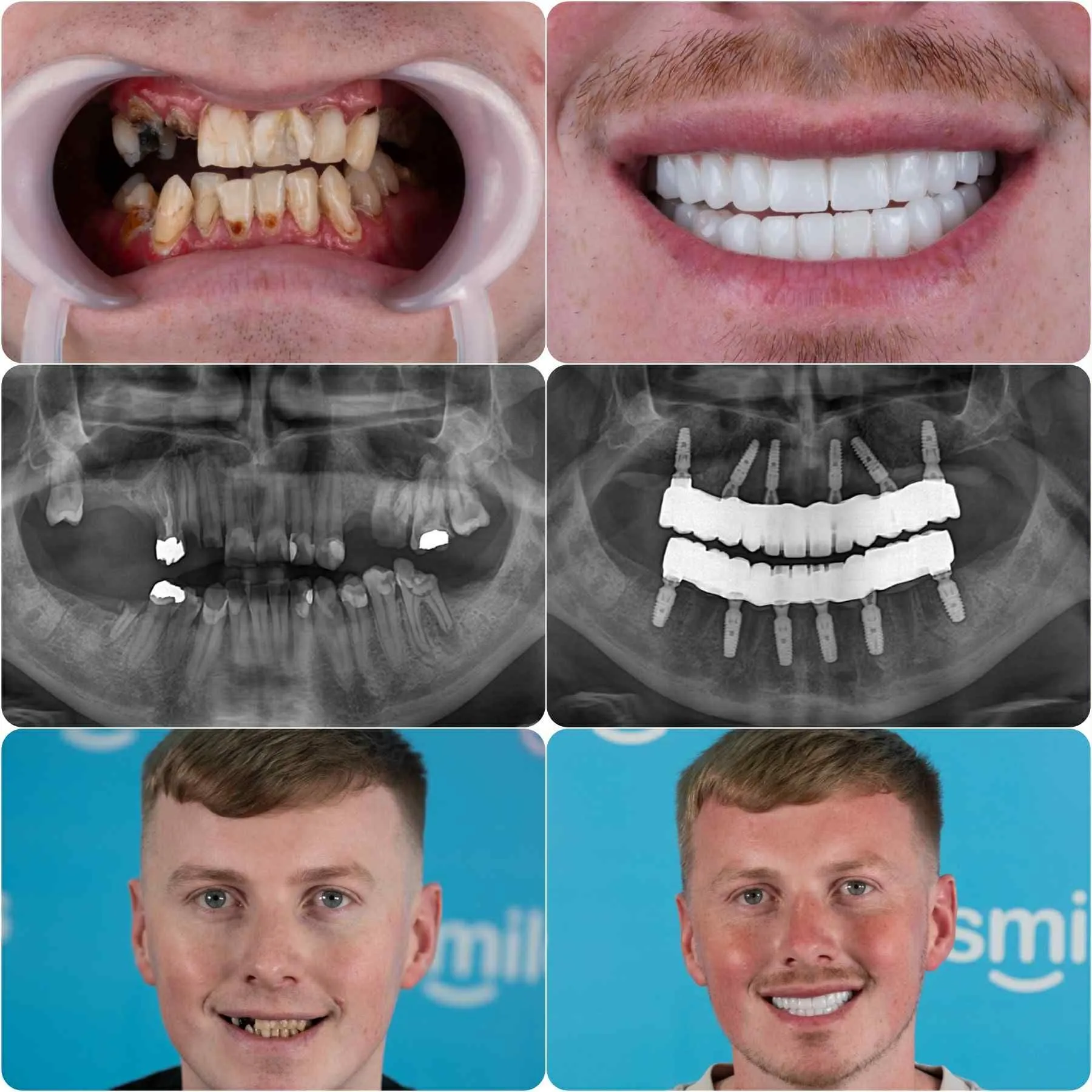
This is why a price for implants without an X-ray is a guess. Here is what a panoramic X-ray looks like before and after full-mouth implants for one of our patients. You can see the dark sinus spaces sitting just above the upper teeth.
If you have not had an X-ray recently, we can arrange one in the UK. Our guide to the consultation you need before treatment in Turkey explains when photos are enough and when they are not.
If the scan does show a shortfall, there are four main ways to fix it.
The Four Ways Bone Is Built Up
“Bone graft” covers several different procedures. They range from a few minutes added to an extraction, to a separate operation that needs months to heal. The material is usually a processed bone substitute, so in most cases nothing is taken from elsewhere in your body.
-
Socket preservation
Graft material packed into the socket straight after a tooth is taken out, so the bone does not collapse while it heals.
- When
- You are having a tooth removed now and want an implant there later.
- Time it adds
- Usually nothing to the timeline. It is done in the same appointment as the extraction.
-
Bone graft (guided bone regeneration)
Graft material placed where the jaw has thinned, covered with a membrane so new bone grows into it.
- When
- The ridge is too narrow or too low to hold an implant fully in bone.
- Time it adds
- Small grafts are often done with the implant. Larger ones go in first and heal for around 3 to 6 months.
-
Internal sinus lift
The sinus floor is gently tapped up through the hole made for the implant, with a little graft underneath.
- When
- Upper back teeth where a few millimetres more height is needed.
- Time it adds
- Usually done with the implant in the same appointment.
-
Lateral sinus lift
A small window is opened in the side of the upper jaw, the sinus lining is lifted, and graft is packed beneath it.
- When
- Upper back teeth where there is very little bone left under the sinus.
- Time it adds
- Sometimes done with the implant. Where bone is very thin, the graft heals first for around 6 months.
What a Sinus Lift Actually Involves
Your sinuses are air spaces in your cheekbones. Their floor sits just above the roots of your upper back teeth. When those teeth are lost, the bone underneath shrinks and the sinus tends to drop into the space, leaving very little bone between your mouth and the sinus.
Put a normal implant there and the tip would go into the sinus. A sinus lift gently raises the thin lining of the sinus floor and fills the space beneath it with graft, so the implant sits fully in bone.
There are two ways to do it. An internal sinus lift works through the implant hole itself, tapping the sinus floor up by a few millimetres. It is quicker, less invasive and usually done at the same appointment as the implant.
A lateral sinus lift opens a small window in the side of the jaw to reach the lining directly. It is used when there is very little bone left, and lets the surgeon add much more graft. It is a bigger procedure and sometimes needs to heal before the implant goes in.
Both are surgery, so they should be planned and done by a dentist with surgical training. You can read about the surgeon who leads implant cases for UK Smiles patients on our team page.
Can You Avoid a Graft?
Sometimes, yes, and a good dentist will tell you when that is a sensible option rather than defaulting to the most work.
- Angled implants. With All-on-4 full-arch implants, the back two implants are tilted to use the denser bone further forward and stay clear of the sinus. That is a big reason it is suggested for people with a lot of bone loss.
- Shorter or narrower implants, where the bone is only slightly short of what a standard implant needs.
- Moving the implant a few millimetres to where the bone is better, if the bite still works.
- Saving the socket at the time of an extraction, so the bone does not shrink in the first place.
None of these is right for everyone. Our comparison of All-on-4 and All-on-6 in Turkey explains why the amount of bone you have often decides between the two.
What It Adds to Your Price
Grafts are priced separately from the implant because not everyone needs one, and the amount varies from person to person. These are the typical prices with UK Smiles. Your own quote will list exactly what your scan shows you need.
| Extra | What it does | Typical price with UK Smiles |
|---|---|---|
| Bone graft | Builds up the width or height of the jaw where it has shrunk | Around £130 per cc of graft material |
| Sinus lift | Raises the sinus floor and adds bone above the upper back teeth | Around £120 to £140 |
| Single implant | For comparison: a MegaGen implant with the abutment | Typically £270 |
A graft for a single tooth usually needs a small amount of material, so it tends to add a modest sum rather than double the bill. Bigger rebuilds across several teeth cost more, which is when angled implants are worth discussing. Our breakdown of dental implant costs in Turkey shows the full price per tooth, by brand and for full arches.
Get your exact price
Answer a few quick questions and the team will come back to you with exactly what you need and what it costs, fixed in writing. Free, no obligation, and nothing to pay up front.
- 4.9 from 310 reviews
- Licensed dental centre in Antalya
- UK office in Leeds
Free online quote form
What It Does to Your Trips
Most implants already take two trips a few months apart: one to place the implant, then a gap while it fuses with the bone, then a second trip for the final teeth. Whether a graft changes that depends on when it is done.
Standard implant
Graft with the implant
Graft first
Small grafts and internal sinus lifts usually fall in the middle row: no extra trip. A graft first is for larger rebuilds where the implant would not be stable in the bone that is there now. Our guide to how long implant treatment in Turkey takes sets out each stage in more detail.
Do Implants in Grafted Bone Last?
Yes, in most cases, though the research is honest that grafted sites carry a little more risk than implants in plenty of natural bone.
98.3%
of implants placed with a lateral sinus lift were still in place after three years, where modern rough-surface implants were used and the window was covered with a membrane.
90.1%
across all 48 studies in the same review, including older techniques and implant surfaces no longer in common use.
A separate long-term study following more than 10,000 implants found those placed with guided bone regeneration failed more often than those that did not need it. That is not a reason to refuse a graft you need. It is a reason to look after it well afterwards, and to choose a surgeon who does this work regularly.
Our guide on how long dental implants from Turkey last covers what keeps implants healthy over the years.
How to Avoid a Surprise on the Day
The stories you hear about prices going up in the chair are nearly always the same story: a quote given without a proper look at the bone. Three questions prevent it.
Has anyone looked at an X-ray or scan of my jaw?
If the answer is no, the price is an estimate. Ask for one before you book.
Does my quote say whether I need a graft or sinus lift?
It should say yes, no, or that it might be needed and what it would cost if so.
If something changes on the day, will you show me why?
You should be shown the scan and given the price before anything extra is done.
Our guide to what a Turkey teeth quote should include shows where grafts and other extras should appear on a written quote.
Frequently Asked Questions
-
How do I know if I need a bone graft for dental implants?
Only an X-ray or 3D scan can tell you. It shows how tall and wide the bone is where each implant would go. People who lost teeth years ago, wore a denture for a long time or had gum disease are more likely to need one, but plenty of them do not. With UK Smiles you know before you book, because the scan comes before the final quote.
-
How much does a bone graft cost in Turkey?
With UK Smiles a bone graft is typically around £130 per cc of graft material, and a sinus lift around £120 to £140. A single-tooth graft usually needs a small amount. Your written quote states exactly what is needed and what it costs, before you travel.
-
Does a bone graft add another trip to Turkey?
Not always. Small grafts and internal sinus lifts are usually done at the same appointment as the implant, so the trips stay the same. A larger rebuild may need the graft to heal for around 3 to 6 months before the implant goes in, which adds time and can add a visit. Your plan will show this before you book.
-
Is a sinus lift painful?
It is done under local anaesthetic, so you should feel pressure rather than pain during it. Afterwards most people have swelling and tenderness for a few days, similar to other implant surgery, and sometimes a stuffy feeling on that side. Sedation is available if you are anxious.
-
Can I fly home after a sinus lift?
Usually yes, but the dentist will tell you how long to wait and what to avoid, such as blowing your nose hard or sneezing with your mouth closed, while the area heals. Mention a likely sinus lift before you book flights so the timing can be planned around it.
-
Can All-on-4 avoid a bone graft?
Often, yes. The back two implants are angled to use the stronger bone further forward and avoid the sinus, which is why All-on-4 is often suggested for people who have lost a lot of bone. It does not suit everyone. Your scan decides.
-
Why did a clinic add a bone graft to my price on the day?
Usually because they priced your treatment without a proper scan, then found less bone than expected once you were in the chair. That is exactly what a scan before booking is meant to prevent. If it happens, you are entitled to see the scan and have the reason explained before you agree to anything.
The quickest way to know if you need a graft is to let the dentists look. Answer a few quick questions, send an X-ray if you have one, and the team will come back with your plan and price in writing, including whether a graft or sinus lift is likely.
Sources
- Tan WL, Wong TL, Wong MC, Lang NP. A systematic review of post-extractional alveolar hard and soft tissue dimensional changes in humans. Clinical Oral Implants Research, 2012. PubMed.
- Pjetursson BE et al. A systematic review of the success of sinus floor elevation and survival of implants inserted in combination with sinus floor elevation. Journal of Clinical Periodontology, 2008. PubMed.
- Royal College of Dental Surgeons of Ontario, How long do implants last?, summarising French D et al., Clinical Implant Dentistry and Related Research, 2021.