

How Long Do Dental Implants From Turkey Last?
A well-placed dental implant is designed to last for life, and long-term research finds more than nine in ten still in place after 10 years. The crown on top wears faster and may need replacing after 10 to 15 years, but that can be done without touching the implant.
Where it was fitted matters far less than how it was planned, which implant was used and how you look after it. Below is what the research says, why the parts wear differently, what shortens an implant’s life, and what to do if something goes wrong once you are back in the UK.
Quick answer · Updated
Dental implants from Turkey can last as long as implants fitted anywhere else. Large reviews find around 93% to 96% of implants still in place after 10 years, and one study of over 10,000 implants found 86% after 15 years. The implant itself can last for life; the crown on top typically lasts 10 to 15 years or more. Smoking, gum disease and skipped check-ups are the main things that shorten an implant's life.
- Implant
- Designed to last for life once fused with the bone
- After 10 years
- Around 93% to 96% of implants still in place
- Crown on top
- Typically 10 to 15 years or more, then replaced
- Biggest risk
- Gum infection around the implant (peri-implantitis)
- Smoking
- More than doubles the risk of losing an implant
- UK Smiles warranty
- 20 years on the implant once fused, 5 years on the teeth
What the Research Shows
Dental implants are one of the best-studied treatments in dentistry, with patients followed for decades. Two large pieces of research give a clear picture.
A 2019 review in the Journal of Dentistry pooled 18 studies that followed patients for at least 10 years. It found 96.4% of implants still in place after a decade. When the authors adjusted for patients who dropped out of the studies, the figure was 93.2%.
A second study followed 10,871 implants in 4,247 patients for up to 22 years, all placed by the same specialist. Here is how many were still in place over time:
Implants still in place
The same study found something useful to know: people with a single implant kept 98.2% of them at 10 years, compared with 90.2% for people with several. People needing several implants are more likely to have had gum disease, and to have less bone, which brings us to why implants are lost.
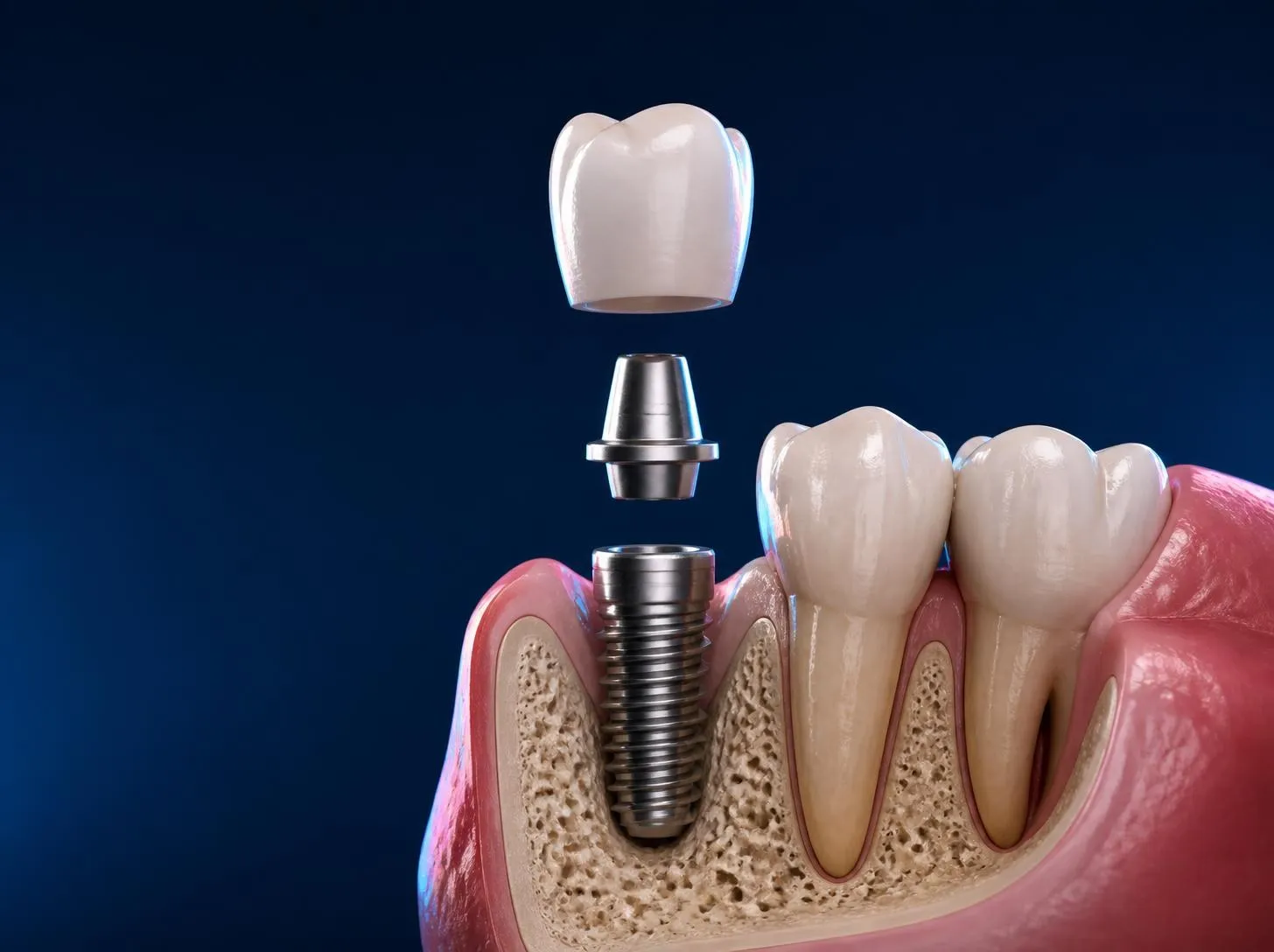
First, though, it helps to know that “an implant” is really three parts.
Three Parts, Three Lifespans
The picture at the top of this page shows them: the implant in the bone, the abutment that connects to it, and the crown you see. They wear very differently, which is why “how long does it last?” has more than one answer.
-
The implant
The titanium post in your jaw
95.2%
still in place after 10 years under single crowns
Once it has fused with the bone, it is designed to stay for life. If it is lost, it is usually because of gum disease around it, not because it wears out.
-
The abutment and screw
The connector between implant and tooth
8.8%
of single implant crowns had a loose screw within 5 years
A loose screw is the most common small problem. It is usually a quick fix that leaves the implant untouched.
-
The crown or teeth on top
The part you see and bite on
89.4%
of single implant crowns still in use after 10 years
Like any crown, it takes the wear. It can chip or need remaking over the years, and it can be replaced without touching the implant.
Figures from a review of single implant crowns followed for an average of 5 years or more (Jung et al., 2012).
So when people talk about an implant “failing”, they often mean a loose screw or a chipped crown. Both are fixable. Our guide to what to do if an implant screw falls out covers the most common one.
Does It Matter That It Was Done in Turkey?
Not in itself. Bone does not know which country it is in. The same things decide how long an implant lasts in Leeds or in Antalya, and they are the things worth checking before you book:
- The implant brand. Established brands have decades of research behind them and parts that UK dentists can get hold of. With UK Smiles, MegaGen is standard, with Osstem, Neodent, Nobel Biocare and Straumann also available.
- A 3D scan before planning. It shows the bone, the sinus and the nerves, so the implant goes where there is enough bone to hold it.
- Who places it. Implants are surgery. They should be placed or led by a dentist with surgical training.
- Time to heal. A proper gap between placing the implant and fitting the final teeth lets it fuse with the bone first.
- Aftercare you can reach. Someone to contact in the UK if something does not feel right.
Rushed treatment is where the risk sits, not the country. Our guide on whether it is safe to have dental implants in Turkey goes through each of these in more depth.
What Shortens an Implant’s Life
Most of what decides how long an implant lasts happens after you get home. These are the things the research links to implants being lost.
-
Biggest risk
Smoking
In a review of over 80,000 implants, smokers lost 6.35% of theirs against 3.18% for non-smokers, more than twice the risk.
-
Biggest risk
Gum disease
A history of gum disease, or poor cleaning around the implant, is the main cause of implants being lost in later years.
-
Raises the risk
Poorly controlled diabetes
Slows healing and raises the risk of infection. Long-term studies show higher failure rates in diabetic patients.
-
Raises the risk
Grinding and clenching
Puts heavy force on the crown and screw. A night guard can protect them.
-
Raises the risk
Skipping check-ups
Early gum problems around implants are reversible. Found late, they are much harder to treat.
-
Worth knowing
Thin or grafted bone
Implants needing a bone graft fail a little more often, so aftercare matters even more.
2.2×
Smokers were more than twice as likely to lose an implant as non-smokers, in a review of 104 studies. Stopping, even just around the time of surgery, helps.
The Biggest Long-Term Risk: the Gum Around It
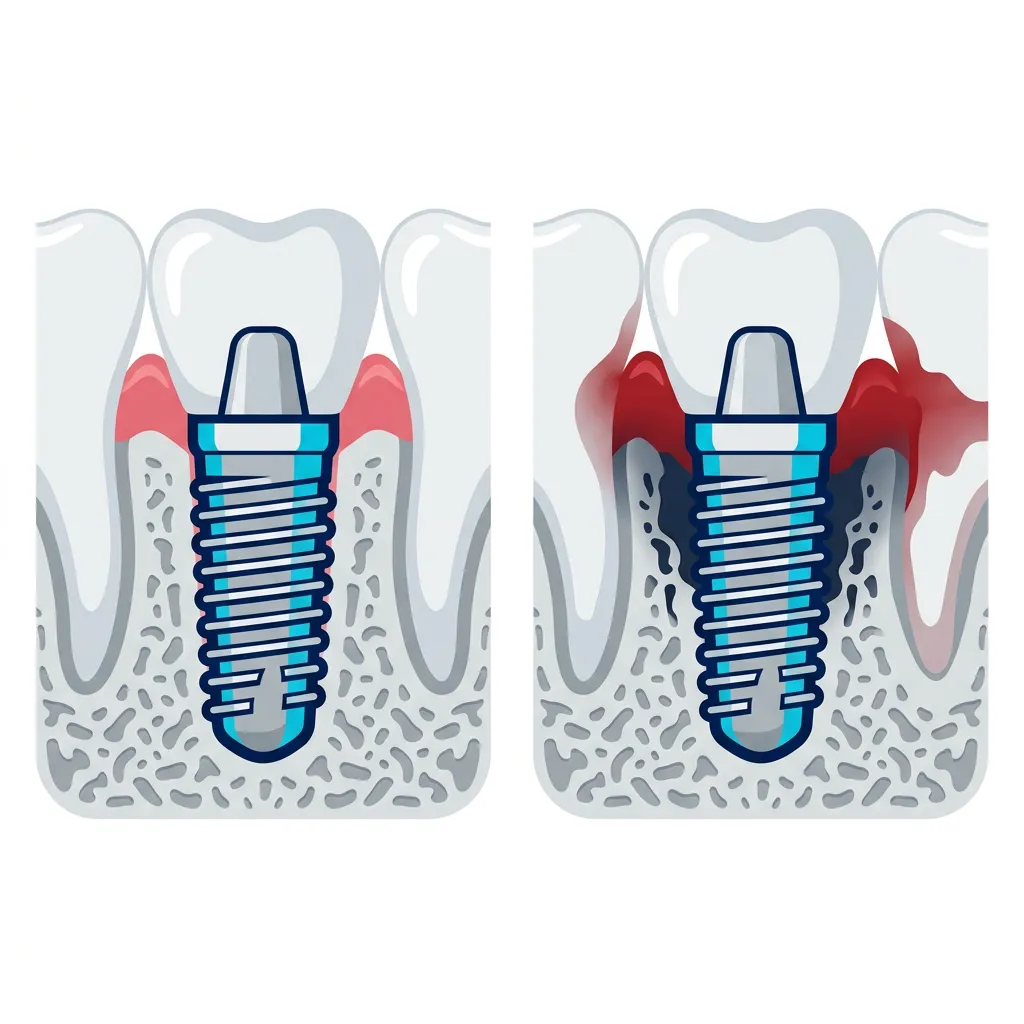
An implant cannot decay, but the gum and bone around it can become infected, just as they can around a natural tooth. It starts as peri-implant mucositis: red, puffy or bleeding gum around the implant. At this stage it is reversible with proper cleaning.
Left alone, it can become peri-implantitis, where the infection starts to eat the bone holding the implant. This is the most common reason implants are lost in later years.
43%
of people with implants had early gum inflammation around them, which is reversible
22%
had peri-implantitis, with bone loss around at least one implant
Those figures come from a review of studies and include people who never had regular check-ups. They are the reason cleaning and check-ups matter so much. If an implant aches, bleeds or feels different years later, our guide to an implant that hurts years later explains the likely causes, and our list of signs of a dental implant infection tells you what to look out for.
How to Make Your Implants Last
None of this is complicated. It is mostly the same care you would give natural teeth, done properly every day.
Clean around them twice a day
Brush where the crown meets the gum, and use interdental brushes or a water flosser underneath bridges.
Keep your check-ups
See your dentist or hygienist regularly and tell them you have implants, so they check the gum around them.
Do not smoke
It is the single biggest thing you control. If you cannot stop for good, stop around the time of surgery.
Protect against grinding
If you clench or grind, ask about a night guard to take the load off your crowns and screws.
Act early
Bleeding, swelling, a bad taste or a crown that moves are worth reporting straight away. Early problems are much easier to fix.
Get your exact price
Answer a few quick questions and the team will come back to you with exactly what you need and what it costs, fixed in writing. Free, no obligation, and nothing to pay up front.
- 4.9 from 310 reviews
- Licensed dental centre in Antalya
- UK office in Leeds
Free online quote form
If Something Goes Wrong Once You Are Home
This is the question to ask any company before you book: who do I call in a year’s time if an implant feels wrong? The answer should not be “book a flight”.
With UK Smiles, you contact the same team you dealt with before your trip. We pass your photos and symptoms to the dentists, arrange an X-ray in the UK where needed, and tell you plainly what happens next. Our UK aftercare page shows how it works, and our guide on who is responsible if an implant fails explains where you stand.
In writing, before you book
What UK Smiles Puts in Writing
20 years
Warranty on the implant once it has fused with the bone
5 years
Warranty on the crowns or teeth fitted on top
MegaGen
Implants as standard, with other leading brands available
3D scan
Before anything is planned, so you know about bone and grafts up front
See how much dental implants cost in Turkey, and what is included.
Frequently Asked Questions
-
How long do dental implants last?
The implant itself is designed to last for life. Long-term research finds around 93% to 96% of implants still in place after 10 years, and around 86% after 15 years in one large study. The crown on top usually needs replacing before the implant does, often somewhere after 10 to 15 years, depending on wear.
-
Do dental implants from Turkey last as long as ones fitted in the UK?
They can. How long an implant lasts depends on the implant brand, how well it was planned and placed, and how it is looked after, not on the country. Ask which implant brand you are getting, whether a 3D scan was used to plan it, and who looks after you once you are home.
-
Can a dental implant last a lifetime?
Many do. Once an implant has fused with the bone and the gum around it is kept healthy, there is nothing in it that wears out. The parts that need attention over the years are the crown and the screw that holds it.
-
How often does the crown on an implant need replacing?
Research on single implant crowns found around 89% still in use after 10 years. Many last longer. Grinding, a heavy bite and chipping shorten it. When a crown is replaced, the implant underneath stays where it is.
-
What is the most common reason dental implants fail?
Early on, it is the implant not fusing with the bone, which smoking and infection make more likely. In later years it is usually peri-implantitis, an infection of the gum and bone around the implant, which is linked to poor cleaning, smoking and a history of gum disease.
-
Do I need to see a dentist in the UK after implants in Turkey?
Yes. Keep seeing your own dentist or hygienist for check-ups and cleaning, and tell them you have implants. Regular professional cleaning is one of the best ways to keep the gum around an implant healthy.
-
What happens if my implant fails after I get home?
With UK Smiles, you contact the same UK team you dealt with before your trip. We pass your photos and symptoms to the dentists, arrange an X-ray in the UK if needed, and work out the next step under your written warranty, which covers the implant for 20 years once it has fused with the bone.
If you are weighing up implants, the most useful next step is a proper plan. Answer a few quick questions, send an X-ray if you have one, and the team will come back with which implants you need, whether a bone graft or sinus lift is likely, and the full price in writing.
Sources
- Howe MS, Keys W, Richards D. Long-term (10-year) dental implant survival: a systematic review and sensitivity meta-analysis. Journal of Dentistry, 2019. University of Liverpool repository.
- Royal College of Dental Surgeons of Ontario, How long do implants last?, summarising French D et al., Clinical Implant Dentistry and Related Research, 2021.
- Jung RE et al. Systematic review of the survival rate and the incidence of biological, technical, and aesthetic complications of single crowns on implants. Clinical Oral Implants Research, 2012. PubMed.
- Derks J, Tomasi C. Peri-implant health and disease: a systematic review of current epidemiology. Journal of Clinical Periodontology, 2015. Summary: The Dental Elf.
- Chrcanovic BR, Albrektsson T, Wennerberg A. Smoking and dental implants: a systematic review and meta-analysis. Journal of Dentistry, 2015. Summary: The Dental Elf.