
Crowns vs Veneers in Turkey: Which One Are You Actually Being Sold?
Crowns and veneers in Turkey differ in one fundamental way: a veneer covers the front surface of a tooth, a crown replaces its entire outer shell. Most packages sold to UK patients as "Turkey veneers" are crowns, and the difference decides how much of your natural tooth survives.
What Is the Difference Between a Crown and a Veneer?
A veneer is a thin ceramic layer bonded to the front of a tooth after minimal surface preparation. A crown is a full cap cemented over a tooth that has been reduced on every side. One is a facade; the other is a rebuild.
| Feature | Laminate veneer | Full crown |
|---|---|---|
| Coverage | Front surface and biting edge | The whole tooth, all the way round |
| Preparation depth | Around 0.3-0.7mm from the front surface | Around 1-2mm from every surface |
| Natural tooth kept | Almost all of it | A substantially reduced core |
| Usual material | E-max lithium disilicate | Zirconia or E-max |
| Strength under load | Excellent on healthy front teeth | Highest, built for molars and damaged teeth |
| Reversibility | Low, but the tooth stays largely intact | None; the tooth needs a crown for life |
| Best for | Colour, shape and gaps on healthy teeth | Broken, root-treated or heavily filled teeth |
| Typical lifespan | 10-15 years with good care | 10-15+ years with good care |
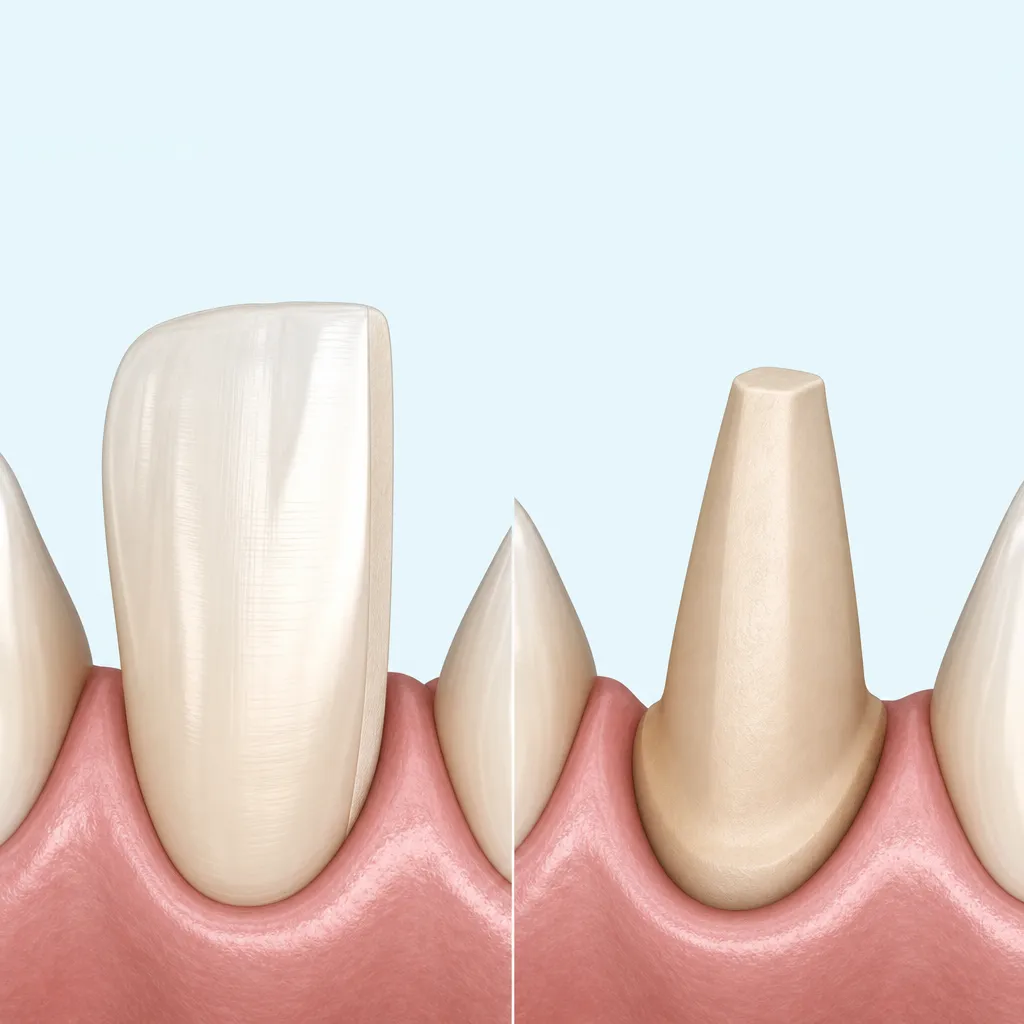
Read the preparation row twice, because everything else on this page flows from it. Enamel does not grow back, so the depth of the drilling is the one decision you cannot revisit later.
Why do the packages push crowns, though?
Why Are Most "Turkey Veneers" Actually Crowns?
Most "Turkey veneers" are crowns because crowns are faster to standardise at package scale. Heavier preparation forgives small errors in impressions and fit, works on crowded or rotated teeth without orthodontics, and lets a high-volume clinic quote one price for almost any mouth that walks in.
The language does the rest. "Zirconium veneers" sounds like a premium veneer; it describes a zirconia crown.
A "full set of veneers" quoted for 20 teeth at a suspiciously uniform price is, in most clinics, a full set of crowns. The famous shaved-peg videos are crown preparation, filmed and captioned as veneers.
Here is the honest part most coverage skips: crowns are not the scam. Crowns are a legitimate, often correct treatment. The scam is preparing your teeth for crowns while your invoice, and your understanding, says veneers.
We have measured out how much enamel is filed down in millimetres if you want the exact figures behind the outrage videos.
Can your quote survive five questions?
How Do You Tell Which One Your Quote Actually Means?
Your quote tells you which treatment you are buying if you make it commit to specifics. Five questions settle it, in writing, before any deposit.
- Ask for the treatment name per tooth: "laminate veneer" or "crown", not "smile makeover" or "zirconium teeth".
- Ask the preparation depth in millimetres. Veneer answers start with a zero; crown answers do not.
- Ask the material. Zirconia strongly implies a crown, because zirconia laminate veneers are rare in practice.
- Ask to see photos of the clinic's prepared teeth from past cases. Pegs mean crowns, whatever the caption says.
- Ask whether your case could be done with veneers at all, and listen for reasoning rather than a pivot back to price.
Price is the quiet confirmation. Crowns and laminate veneers sit in different per-tooth bands at any honest clinic, with E-max laminates usually the more expensive line on the page. The full breakdown of turkey teeth cost by treatment type shows the bands side by side, which makes a mislabelled quote easy to catch.
When Are Crowns Genuinely the Right Call?
Crowns are the right call when the tooth itself is compromised: root canal treated, cracked, heavily filled, badly worn or already crowned once. In those cases the tooth needs structural protection all the way round, and a veneer would be a decorative answer to an engineering problem.
Heavy grinders often land here too. Bruxism loads teeth in ways that favour zirconia's strength, and a well-made crown on a ground-down molar is restoration, not vanity. Whole-bite rebuilds, where worn teeth have collapsed the height of the face, are crown territory almost by definition.
Well-planned full dental crowns in Turkey follow a rule you can hear in the consultation: the treatment is chosen per tooth, from X-rays and photographs, with reasons attached. A plan with 8 crowns where the damage is and 12 untouched teeth is a diagnosis. A plan with 28 of anything is a price list.
For what happens after the fitting, crown lifespans run long when the case selection was honest in the first place.
When Should You Insist on True Veneers?
Insist on veneers when your teeth are healthy and your goals are cosmetic: colour that whitening cannot fix, small gaps, minor rotations, edges worn just enough to age the smile. Healthy enamel is exactly the thing veneers preserve and crowns spend.
The maths of a 25-year-old matters here. Restorations last 10 to 15 years, so a smile done at 25 faces several replacement cycles.
Each veneer replacement works with a mostly intact tooth. Each crown replacement digs into an already reduced core, and by the third cycle the conversation can involve root canals.
This is why true laminate veneers are the version of this treatment we argue for whenever the teeth qualify: 0.3 to 0.7 millimetres of preparation, pressed E-max, and a tooth underneath that still has its future intact.
If a clinic says your teeth do not qualify, ask why. Sometimes the answer is genuine. Sometimes it is a schedule.
Are No-Prep Veneers in Turkey Real?
No-prep and minimal-prep veneers exist, and they are honestly offered for a narrow band of cases: small teeth, gaps to close, smiles being built outwards rather than reshaped. Ultra-thin ceramics bond straight onto barely touched enamel, which is as reversible as ceramic work gets.
The catch is candidacy. Teeth that are already prominent, bulky or crowded gain thickness from no-prep work and end up reading as piano keys, so a clinic offering no-prep veneers to every enquiry is marketing, not planning.
Treat the phrase as a question to ask rather than a product to order: would my case suit minimal preparation, and if not, why not. The quality of that answer tells you more about a clinic than its price list does.
Thought about your teeth at sixty?
What Does the Choice Mean for Your Enamel Long Term?
The crown decision is permanent in a way no other line on the quote is. A crowned tooth has lost its enamel shell and will wear a crown for the rest of its life, through every replacement, whatever you choose next time.
A veneered tooth keeps its options. If a veneer fails, the tooth beneath can usually take a new veneer, or a crown if things have worsened, or occasionally nothing but polish. Options are exactly what you want your 40-year-old self to inherit from this decision.
So the question to carry into any Turkish consultation is not "crowns or veneers?" in the abstract. It is "which does each tooth need, and how little can we remove to get there?". Clinics that like that question are the ones to shortlist.
The Decisions Either Side of This One
Crowns and veneers share a chapter, not the whole book, and the neighbouring choices deserve the same scrutiny. Both treatments come in E-max and zirconia versions with different strength and translucency trade-offs, and the materials used for each explain half the price differences between quotes.
At the lighter end, minor chips and edge wear sometimes need no ceramic at all, which is where composite bonding fits: same-day resin work that keeps every micron of enamel and costs a fraction of either option here.
At the heavier end, teeth that are loose, failing or already missing have left veneer territory entirely, and where implants take over is its own decision with its own timeline, worth reading before any full-mouth consultation.
Frequently Asked Questions
-
Are zirconium veneers really veneers?
Usually not. "Zirconium veneers" on a Turkish price list almost always describes zirconia crowns, which cover the whole tooth after all-round preparation. True laminate veneers are thin front-surface shells, nearly always made from E-max or similar pressed ceramics. If the word zirconium appears, ask for the preparation depth in writing.
-
Why do Turkish clinics fit so many crowns?
Volume clinics favour crowns because they standardise well: heavier preparation tolerates imperfect impressions, works on crooked teeth without orthodontics, and fits a fixed package price. That is a business model, not a conspiracy, but it means the treatment decision can default to crowns unless you ask the veneer question explicitly.
-
Can a crowned tooth go back to being a veneer case?
No. Crown preparation removes the enamel a veneer would bond to, so a crowned tooth stays a crowned tooth through every future replacement. This one-way door is the strongest argument for choosing the least invasive treatment your teeth honestly qualify for, especially under 40.
-
Do crowns last longer than veneers?
Slightly, on average, because crowns are thicker and built for load. Both sit in the 10-to-15-year range with good care, and both fail early for the same reasons: grinding without a night guard, poor fit at the margins, and neglected gums. The lifespan gap is smaller than the enamel cost that buys it.
-
Is a full set of crowns ever the right cosmetic choice?
Occasionally, yes: severely worn dentitions, tetracycline staining too deep for veneers to mask, or mouths already carrying many old crowns and fillings. What should make you pause is a full set proposed without X-rays, tooth-by-tooth reasoning, or any mention of the veneer alternative. The plan should read like a diagnosis, not a menu.