
Turkey Teeth Filed Down: How Much Enamel Is Actually Removed?
Turkey teeth are filed down by around 0.3mm to 0.7mm for laminate veneers and 1mm to 2mm on every surface for full crowns. That gap decides whether your tooth keeps most of its enamel or loses the majority of its structure.
The famous "shark teeth" videos show the second kind of preparation, not the first. Most of the confusion around this topic disappears once those two procedures stop sharing one name.
How Much Tooth Is Removed for Each Treatment?
Tooth removal ranges from almost nothing for composite bonding to the majority of the visible tooth for a full crown. The table below puts the three main turkey teeth treatments side by side, in millimetres and as a share of the tooth.
| Treatment | Typical surface reduction | Share of visible tooth structure removed | Where it is removed |
|---|---|---|---|
| Composite bonding | Often none, up to around 0.5mm | Minimal | Light surface roughening only |
| Laminate veneer | Around 0.3mm to 0.7mm | Roughly 3% to 30% | Front surface, sometimes the edge |
| Full crown | Around 1mm to 2mm | Roughly 63% to 72% | Every surface, the whole way round |
Surprised how far apart those numbers sit?
Those percentages are measured, not marketing. A Journal of Prosthetic Dentistry study weighed the tooth structure removed by each preparation design and found veneer preparations removed roughly 3% to 30% of the crown of the tooth, against 63% to 72% for full-coverage crown preparations [1].
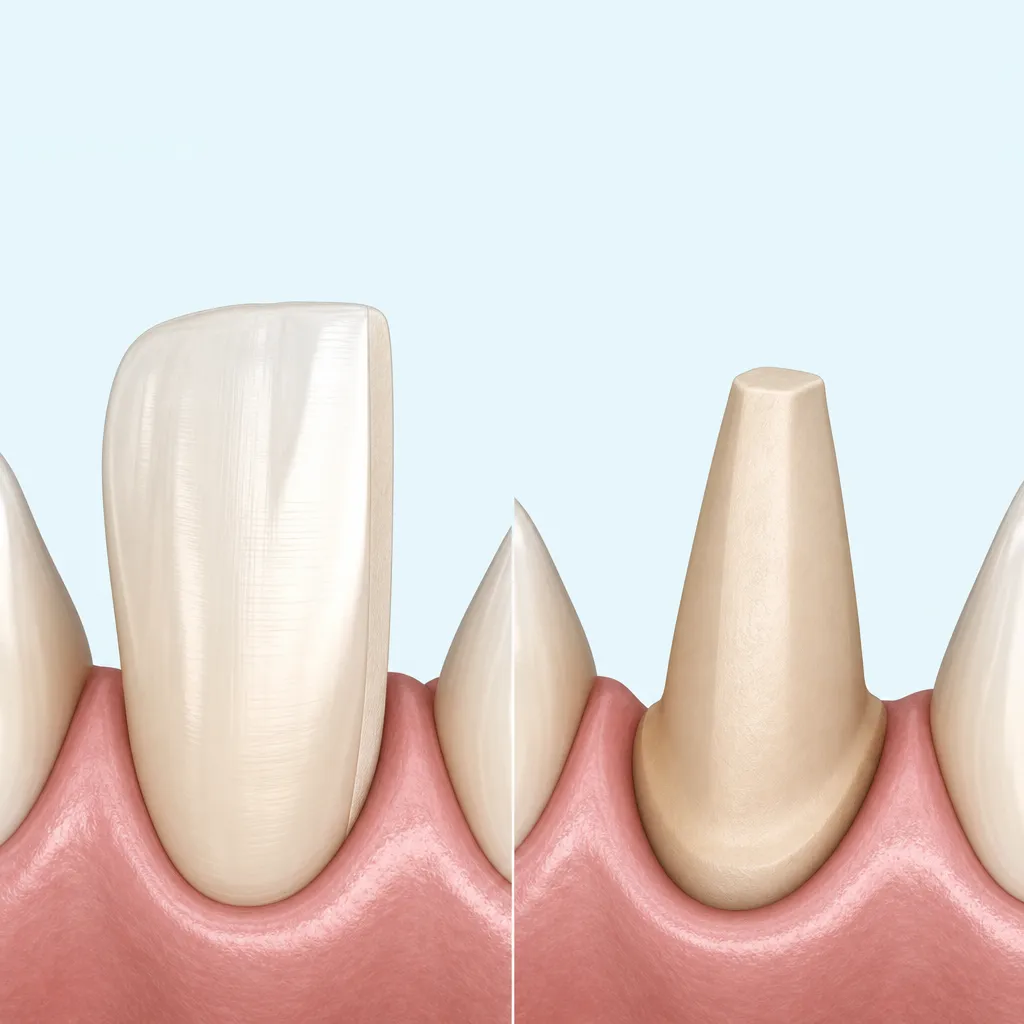
The same study found a metal-ceramic crown preparation removed 4.3 times more tooth than a front-surface veneer preparation. One is a resurfacing job. The other rebuilds the tooth from a carved-down core.
"By weight" matters in that finding. The researchers measured the actual substance of tooth removed, rather than depth on one surface.
A crown does not simply go a bit deeper than a veneer. It takes the corners, the biting edge and the back wall too.
Composite bonding earns its row in the table as well. For chips, small gaps and edge wear, bonding adds material instead of removing it, which is why an honest consultation sometimes quotes bonding when you asked about veneers.
So why do the videos look so brutal?
Why Do the "Shark Teeth" Videos Look So Extreme?
The shark teeth videos look extreme because they show full-coverage crown preparation on many teeth at once, filmed mid-treatment. Twenty teeth reduced by 1mm to 2mm each, on camera, is genuinely dramatic footage even when the dentistry is competent.
Some of those videos also show preparation done badly: stumps over-tapered into spikes, which removes even more tooth than a crown needs and weakens the grip of the final restoration. The camera cannot tell you which you are watching. The peg shape alone is not proof of malpractice, and it is not proof of care either.
The clips reveal one more thing without meaning to. Prepared teeth are normally covered with temporaries the same day, so a patient filming bare pegs back at the hotel has been sent out unprotected, with dentine open to air, coffee and buffet sugar. That detail says more about the clinic than the pegs do.
What the videos never show is a correct laminate veneer preparation, for a simple reason: it is boring. The tooth afterwards looks like a slightly matte version of itself. We describe what happens to teeth under Turkey veneers separately, including why a well-prepped tooth stays sealed and healthy.
Sure which preparation your quote actually means?
How Do You Know Which Preparation You're Being Quoted For?
You find out by asking one written question: "Is my plan laminate veneers or full-coverage crowns, tooth by tooth?" Much of what is sold to UK patients as Turkey veneers is actually crowns, and the quote often will not say so unless pushed.
Put the question in writing and keep the reply. The quotes that fail this test tend to fail by omission: "full set of premium zirconia" with no treatment name anywhere, which in practice means crowns.
The word "veneers" appears in packages because it sounds gentler and searches better. The honest answer is sometimes genuinely crowns, and often mixed: crowns on broken or root-treated teeth, veneers on healthy ones.
What matters is that the plan matches each tooth's condition rather than a package template. Our guide to whether you're being sold crowns or veneers shows how to read a quote line by line.
Where teeth are healthy and the goal is cosmetic, we default to minimal-prep E-max laminate veneers, because they leave the enamel story intact. Where a tooth is heavily filled, cracked or already root-treated, full crowns in Turkey are the right tool, and the extra reduction is a fair trade for strength.
Does Filed-Down Enamel Grow Back?
No. Enamel does not regrow, because it contains no living cells to rebuild it. Whatever is removed in preparation is gone for the rest of your life, and every future replacement restoration starts from that reduced baseline.
Dentine is the layer that complains. Once preparation passes through the enamel, the tooth's living layer is what gets covered, and it registers cold, sweet and air as sharp little warnings.
A sealed, well-fitted restoration quiets it. A leaking one lets it grumble for years.
That is the real reason prep depth deserves more attention than price or shade. A 0.5mm veneer preparation leaves the decision partly open for your future self. A 2mm crown preparation on a healthy tooth commits that tooth to crowns forever.
Removing enamel is not automatically harm, though. Sealed under a well-made restoration, a conservatively prepared tooth can stay healthy for decades. The evidence on whether Turkey veneers damage your teeth comes down to that same distinction: preparation depth and fit quality, not the veneer itself.
Where the Enamel Question Leads Next
Preparation depth is half the materials conversation. The ceramic that goes on top, E-max lithium disilicate, zirconia or layered porcelain, decides how thin a restoration can be while surviving a British diet, which in turn decides how much tooth must be removed to fit it. Here is what turkey teeth are actually made from, system by system.
Frequently Asked Questions
-
Can you get veneers with no filing at all?
Sometimes. No-prep veneers exist for small, inward-leaning or worn teeth, where adding a thin ceramic layer improves shape without bulk. On average-sized straight teeth, skipping preparation entirely tends to look thick and shelf-like at the gum, so most cases still need light reduction.
-
Does having teeth filed down hurt?
No, the preparation itself is done under local anaesthetic and you feel vibration rather than pain. Some sensitivity to cold for a week or two afterwards is normal, especially after deeper preparation. Pain that builds rather than settles is not normal, and needs a call to the clinic.
-
How much enamel does a front tooth have to lose?
Front-tooth enamel is only around a millimetre thick at its thickest, thinning towards the gum. A 0.5mm veneer preparation stays mostly inside it. A 1.5mm crown preparation goes well beyond it into dentine, which is why the veneer-or-crown decision matters more than any brand name.
-
What happens if too much tooth is removed?
Over-preparation risks nerve inflammation, sensitivity and a weaker foundation for the restoration. Some over-prepared teeth later need root canal treatment. It is the single most common problem we see in repair cases from cut-price full sets, and the least fixable, because the tooth cannot be added back.
Get your free treatment quote from Antalya
References
- [1] Journal of Prosthetic Dentistry (Edelhoff D, Sorensen JA, 2002, via PubMed) - measured percentages of coronal tooth structure removed by veneer and crown preparation designs - pubmed.ncbi.nlm.nih.gov - accessed July 2026.