
How Long Do Crowns From Turkey Last?
Crowns fitted in Turkey last as long as crowns fitted anywhere: around 10 to 15 years as a guide, and often longer. Lifespan depends on the material, the quality of the dental laboratory and how you look after them, not the country.
That answer needs unpacking, because "crown" covers several materials with different track records. And because the gap between a good Turkish lab and a rushed one is the real story behind every "my Turkey teeth fell apart" headline.
How long does each crown material last?
Zirconium crowns last around 15 years or more with good care, E-max crowns around 10 to 15 years, and porcelain-fused-to-metal crowns a similar 10 to 15, although their appearance usually fails years before their structure does.
| Crown material | Typical lifespan | Main strength | Weak point |
|---|---|---|---|
| Zirconium (zirconium dioxide) | 15+ years as a guide | The strongest ceramic used in dentistry, very hard to fracture | Budget monolithic versions can look opaque and flat |
| E-max (lithium disilicate) | 10 to 15 years, often longer | Handles light the way natural enamel does | Less forgiving under heavy grinding |
| Porcelain-fused-to-metal | 10 to 15 years structurally | Proven metal core with decades of clinical history | Dark line at the gum as it ages, and porcelain can chip off the metal |
The peer-reviewed data backs the ceramics. A systematic review by Pieger, Salman and Bidra found that 97.8% of lithium disilicate single crowns, the material sold as E-max, were still in service at five years, and 96.7% at ten years [1].
Those figures describe crowns made properly and looked after properly. They are what the material can do, not what every clinic delivers with it.
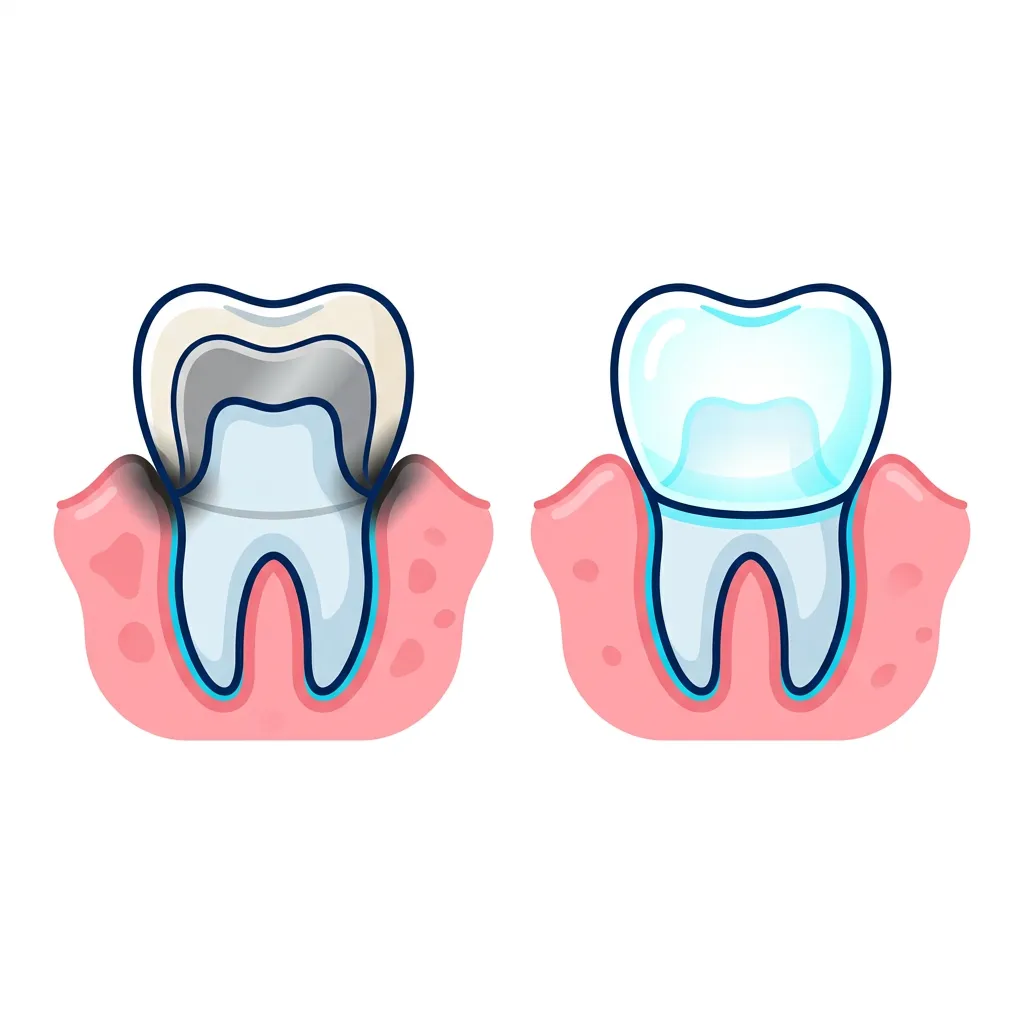
The zirconium and E-max crowns fitted in Turkey at a properly run clinic use the same branded ceramic systems a UK laboratory buys. Ivoclar makes E-max in Liechtenstein; the chemistry does not change at the border.
Placement matters as much as brand. In a well-planned mouth, zirconium usually goes on molars, where bite forces peak and nobody studies your teeth, and E-max goes on the front teeth, where light handling decides whether crowns read as teeth or as dental work.
What knocks years off those figures, then?
What shortens the life of a crown from Turkey?
Grinding, gum disease and poorly fitting margins shorten a crown's life more than anything else. Where the crown was made matters far less than how precisely its edge meets your tooth and how healthy the gum around that edge stays.
- Teeth grinding. Bruxism loads a crown with sideways forces it was never designed to absorb. Grinders need harder materials and a night guard, or the expected lifespan roughly halves.
- Gum disease. A crown's margin sits at the gum line. Inflamed, receding gums expose that margin and let bacteria work underneath it.
- Poor margin fit. A gap of a fraction of a millimetre between crown and tooth becomes a trap for plaque, then decay. That is a lab and dentist problem, not a material problem.
- Decay in the tooth underneath. The crown itself cannot rot. The natural tooth under it can, and it usually does so quietly at the margin.
- Hard habits. Ice, pen lids, ripping open packets with your teeth. Ceramic tolerates chewing; it dislikes surprises.
- Skipped check-ups. Small margin problems caught early get polished or repaired. Caught late, the whole crown comes off.
Ever wondered who actually makes your crown?
What does a good dental laboratory change?
The laboratory decides how well the crown fits, whether the ceramic is genuine and how natural the shade layering looks. Two crowns can carry the same material name and behave completely differently, because one was milled and finished with time and one was rushed overnight.
The pattern behind most short-lived Turkey crowns is speed. High-volume clinics promising full sets in three days lean on labs working through the night, and margin precision is the first casualty.
A careful lab scans the preparation digitally, mills the crown, tries it in, adjusts the fit, builds the shade in layers and glazes it. That work is why E-max crowns from a good lab look like teeth rather than bathroom tiles.
Ask any clinic two questions before you book. Which laboratory makes your crowns, and how many days sit between preparation and final fitting. Vague answers to either are your cue to keep looking.
How do you know when a crown is failing?
A failing crown announces itself with a dark line at the gum, new sensitivity, a bad taste that keeps returning, movement under pressure or a visible chip. Any one of these deserves a dentist's attention within weeks, not months.
The bad taste is the sign people dismiss longest and should dismiss least. It usually means the cement seal has broken and fluid is seeping under the crown, which is decay's invitation. A reseal caught early can save both crown and tooth.
The dark line deserves its own explanation, because it has three different causes and only one of them is serious. We cover why a black line appears at the gum separately, including the cases you can safely ignore.
None of these signs means the crown fails tomorrow. They mean the clock has started, and acting early is usually the difference between a small repair and a full remake. Knowing when crowns need replacing helps you judge the urgency honestly.
Sure you were even quoted crowns?
Where crowns sit in your wider research
Most full-set quotes from Turkish clinics are crown work even when the sales page says veneers, and that difference decides how much natural tooth survives preparation. Understanding crowns versus veneers in Turkey before you compare quotes keeps that decision in your hands rather than the clinic's.
Lifespan is also partly homework. Brushing with a non-abrasive paste, flossing the margins gently and keeping the gum line clean are the daily care that extends a crown's life by years, whichever material sits on the tooth.
Frequently Asked Questions
-
Do crowns from Turkey last as long as crowns fitted in the UK?
Yes, when material, laboratory quality and fit are equal. A well-made zirconium or E-max crown does not know where it was cemented. The honest caveat: quality varies more between Turkish clinics than between UK ones, so clinic choice does the heavy lifting.
-
Which lasts longer, zirconium or E-max?
Zirconium, on raw strength. It resists fracture better under heavy load, which is why it suits molars and grinders. E-max trades a little strength for much better light handling, so front teeth usually get E-max and back teeth zirconium in a well-planned mouth.
-
Can a crown last 20 years or more?
Plenty do. Crowns fitted with precise margins, on healthy gums, in mouths that get cleaned daily and checked yearly, regularly pass 20 years. The 10-to-15-year figure is an average dragged down by grinders without night guards and margins that were wrong from day one.
-
Does a crown protect the tooth underneath from decay?
Only the part it covers. The margin where crown meets tooth stays vulnerable, and decay there is the most common reason crowns come off early. Daily cleaning along the gum line matters more after crowns are fitted than it did before them.
-
How often should crowns be checked after treatment in Turkey?
Once a year by any dentist, the same as natural teeth, with a hygienist visit every six months if your gums have history. The check takes minutes: margins probed, bite reviewed, gums measured. A UK practice can do all of it without knowing where the crown was made.
Get your free treatment plan and quote
References
- [1] Pieger S, Salman A, Bidra AS, The Journal of Prosthetic Dentistry - cited for lithium disilicate single crown survival rates of 97.8% at five years and 96.7% at ten years - pubmed.ncbi.nlm.nih.gov - accessed July 2026.