
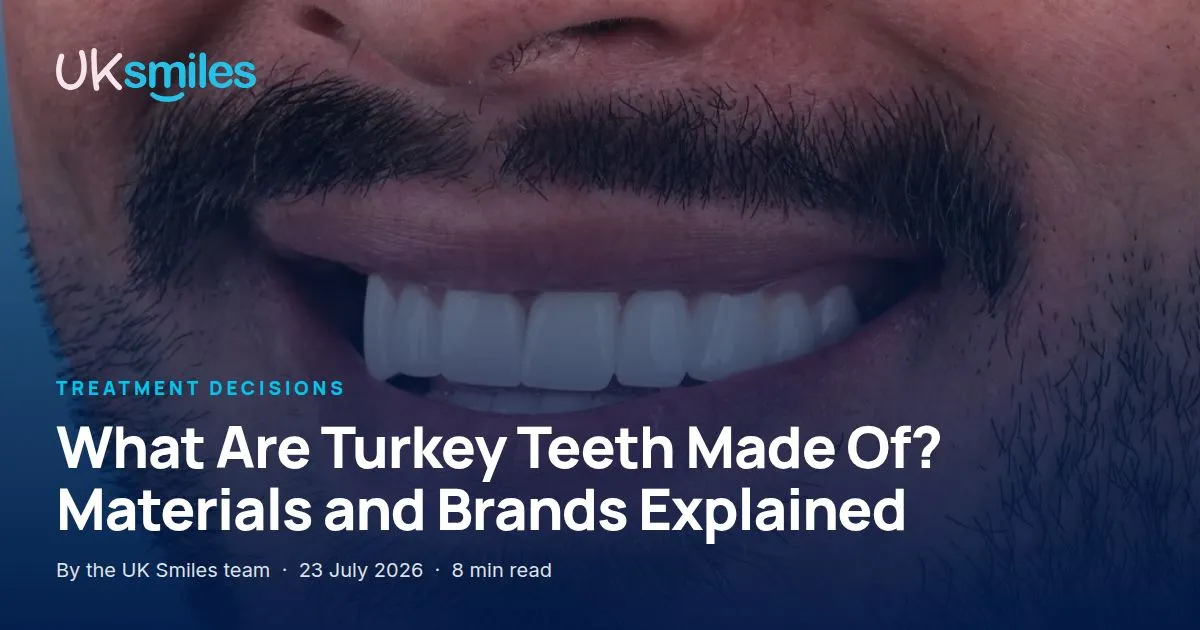
What Are Turkey Teeth Made Of? Materials and Brands Explained
Turkey teeth are made of four main materials: E-max lithium disilicate ceramic, zirconium dioxide, porcelain fused to metal, and composite resin. The first two account for most work at reputable Turkish clinics, and the material named on your quote decides strength, translucency and lifespan.
What Are the 4 Materials Used for Turkey Teeth?
The 4 materials behind turkey teeth are lithium disilicate (sold as E-max), zirconium dioxide (zirconia), porcelain fused to metal (PFM), and composite resin. Each occupies a different point on the trade-off between strength and how convincingly it imitates enamel.
| Material | What it is | Strength (flexural) | Translucency | Usual treatment in Turkey |
|---|---|---|---|---|
| E-max (lithium disilicate) | Glass-ceramic, pressed or milled | Around 400-500 MPa | High, closest to enamel | Laminate veneers, front crowns |
| Zirconium dioxide | Milled and sintered ceramic | Around 900-1,200 MPa | Lower, improving in newer multilayer blocks | Full crowns, bridges, molars |
| Porcelain fused to metal | Metal core layered with porcelain | Strong core, weaker porcelain layer | Low, opaque with a hidden metal line | Budget crowns, older-style bridges |
| Composite resin | Tooth-coloured resin sculpted by hand | Around 100-150 MPa | Good when fresh, dulls with age | Bonding, edge repairs, small gaps |
Already picked a row from that table?
Those strength figures explain most treatment decisions before anyone opens your mouth. A molar that grinds through steak every day wants zirconia's numbers; a front tooth on show in every photograph wants E-max's optics.
What Is E-max, and Why Does Every Clinic Mention It?
E-max is a brand name, not a material class. IPS e.max is made by Ivoclar, a Liechtenstein dental manufacturer, and it is the most widely used lithium disilicate system in the world, which is why the name appears on almost every Turkish price list.
Lithium disilicate is a glass-ceramic, either pressed from heated ingots or milled from blocks by a CAD/CAM machine. Its selling point is the combination: strong enough for front teeth and thin veneers at around 400-500 MPa, translucent enough to pass for enamel in daylight.
That translucency is the reason E-max dominates cosmetic work. Light passes partway into the ceramic and scatters, the same trick natural enamel performs, so an E-max veneer avoids the flat, painted look that gives cheap work away.
Our E-max ceramic crowns use the same Ivoclar material pressed as a full-coverage crown, which is the usual choice when a front tooth needs more than a veneer can give.
What Is Zirconium, and When Is It the Stronger Choice?
Zirconium dioxide is the strongest ceramic in routine dental use, at roughly two to three times the flexural strength of lithium disilicate. Crowns are milled from pre-sintered zirconia blocks, then sintered in a furnace, where they shrink and harden into their final form.
That strength makes zirconia the default for molars, bridges and anyone who grinds their teeth. It is the material you want doing the structural work at the back of the mouth, where forces are highest and nobody is judging translucency.
Zirconia comes in two builds worth knowing about. Monolithic crowns are milled from a single block, with nothing to chip. Layered zirconia adds a hand-finished porcelain surface for better aesthetics, at the cost of a weaker outer layer.
Newer multilayer blocks split the difference, and they have narrowed the looks gap on E-max considerably.
Full zirconium crown treatment is what a large share of "Turkey teeth" packages actually consist of, whatever word the sales page uses, and there are cases where that is exactly the right prescription.
Why does metal still turn up, then?
Why Do Some Clinics Still Fit Porcelain Fused to Metal?
Porcelain fused to metal survives on price. A PFM crown has a cast metal core, usually a cobalt-chromium or nickel-chromium alloy, with porcelain baked over the top, and it costs a lab a fraction of what pressed ceramic does.
The compromises are visible ones. The metal core blocks light, so PFM crowns look opaque next to natural teeth, and as gums recede over the years the metal edge can appear as a grey line at the gum. The porcelain layer can also chip away from the metal beneath it.
PFM still has a defensible place on a back molar for a patient watching every pound. On front teeth it is a false economy, and a clinic proposing it for a smile makeover in 2026 is telling you something about its lab budget.
Where Does Composite Resin Fit In?
Composite resin is the material of bonding rather than veneers or crowns. A dentist sculpts the resin directly onto the tooth and cures it with light, all in one visit, with no laboratory involved.
Composite is the cheapest and most reversible option on this page, and the shortest-lived. It picks up stains faster than any ceramic, dulls as it ages, and does its best work on chipped edges, small gaps and minor reshaping rather than full smile changes.
Plenty of people fly to Turkey expecting veneers and leave with composite bonding on four teeth and money still in their account, because that was what the case honestly needed.
How Do the Materials Age Over Ten Years?
Ten years separates these materials more clearly than day one does. E-max holds its glaze and translucency well, with failure usually arriving as a single debonded or fractured unit rather than gradual decline. Zirconia barely wears at all; its watch point is the gum line, where recession can expose a crown margin.
PFM ages most visibly. The porcelain layer chips, and the metal edge that was invisible at fitting shows as a grey shadow once gums move. Composite ages fastest of all, dulling and staining until a polish stops rescuing it, usually within 5 to 8 years.
The honest summary: ceramics fail as events, composite fails as a fade. Which you prefer depends on whether you would rather budget for one replacement or accept gradual touch-ups, and a good consultation puts that choice in front of you rather than deciding it silently.
Dare to decode your own quote?
Which Material Will Your Quote Actually Mean?
Most Turkish quotes come down to a choice between E-max and zirconia, and the wording deserves attention. "Zirconium veneers" almost always means zirconia crowns, which is a different treatment with a different preparation, so crowns versus veneers, settled properly, is worth ten minutes of your research time.
The preparation is where materials stop being abstract. An E-max laminate veneer needs a fraction of a millimetre of surface enamel; a zirconia crown needs the whole tooth reduced on every side. We have set out how teeth are filed down and prepared for these materials in millimetres, because that number matters more than any brand name.
Three questions settle most quotes. Which material, by brand, for which teeth. Which laboratory makes the work, in-house or outsourced. And can the clinic show the authenticity card, since Ivoclar supplies one with genuine E-max, batch number included.
A clinic using the real thing answers all three without blinking.
All four materials sit inside the treatments behind turkey teeth, from single crowns to full smile designs, and the honest version of that page tells you which material we would put in our own mouths for each job.
Where This Fits in Your Research
Material chosen, the next variable is colour. E-max and zirconia both come in every step of the shade guide, from natural A-shades to the bleach range, and the turkey teeth colour chart, with shades explained, sets out how to pick a white that photographs well without announcing itself in daylight.
Materials are also half of the safety conversation. The other half is planning, preparation depth and who is holding the handpiece, so the safety picture in full puts E-max and zirconia alongside the clinic-level factors that decide outcomes.
And if you are wondering why a British nickname exists for Turkish dentistry at all, how turkey teeth became a phenomenon traces the trend from early package holidays to the TikTok era, shark-teeth videos included.
Frequently Asked Questions
-
Are turkey teeth real teeth or false teeth?
Turkey teeth are restorations fixed onto your own teeth, not dentures. Veneers and crowns made from E-max or zirconia are bonded or cemented onto prepared natural teeth, so they are not removable. The natural tooth stays alive underneath, which is exactly why preparation depth matters so much.
-
Is E-max better than zirconia?
Neither wins outright; they solve different problems. E-max looks more like enamel and suits veneers and front crowns, while zirconia is roughly twice as strong and suits molars, bridges and heavy grinders. A well-planned full-mouth case often uses both, matched in shade so the join is invisible.
-
How do you know a clinic uses genuine E-max?
Ask directly, then ask for evidence. Genuine Ivoclar E-max comes with an authenticity card carrying a batch number, and a clinic using the real material will name its laboratory without hesitation. Generic lithium disilicate exists and can be respectable, but it should be priced and described as what it is.
-
Which turkey teeth material lasts longest?
Zirconia typically has the longest service life thanks to its strength, with E-max close behind when it is bonded well and kept away from ice-crunching habits. Both ceramics commonly pass 10 to 15 years with decent care. Composite sits around 5 to 8 years, and PFM's weak point is chipped porcelain rather than the core.
-
Are these the same materials UK dentists use?
Yes. E-max, zirconia and modern composites are global products from the same manufacturers, and a UK lab orders from the same catalogues as an Antalya one. The difference between countries is labour cost and lab time, not the box the ceramic arrives in.