
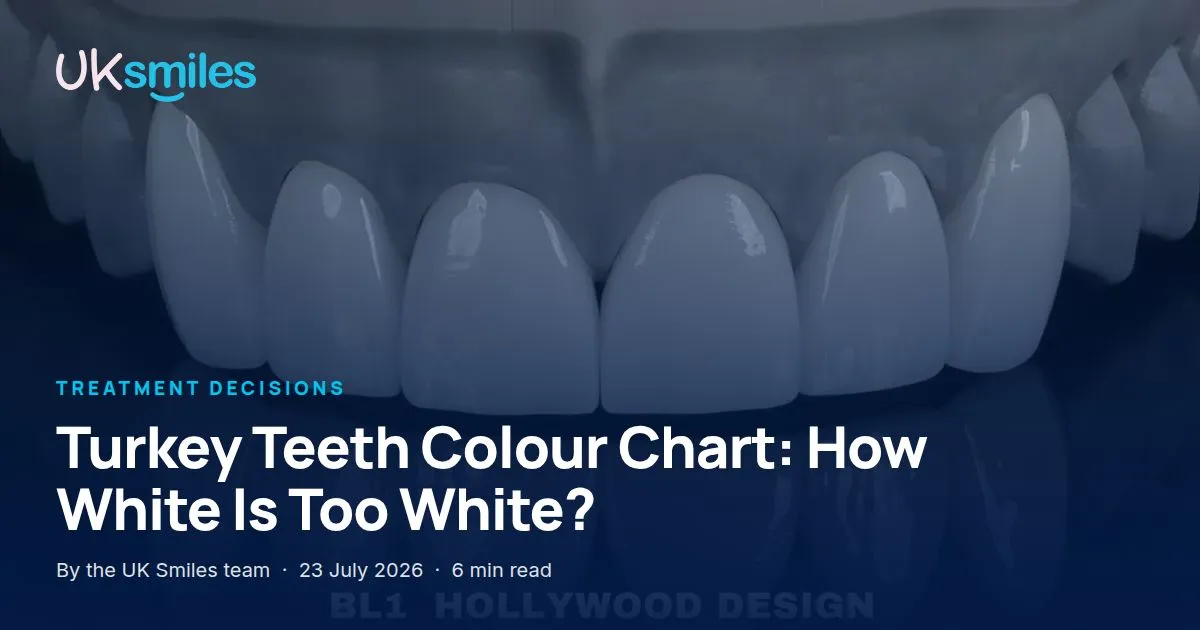
Turkey Teeth Colour Chart: How White Is Too White?
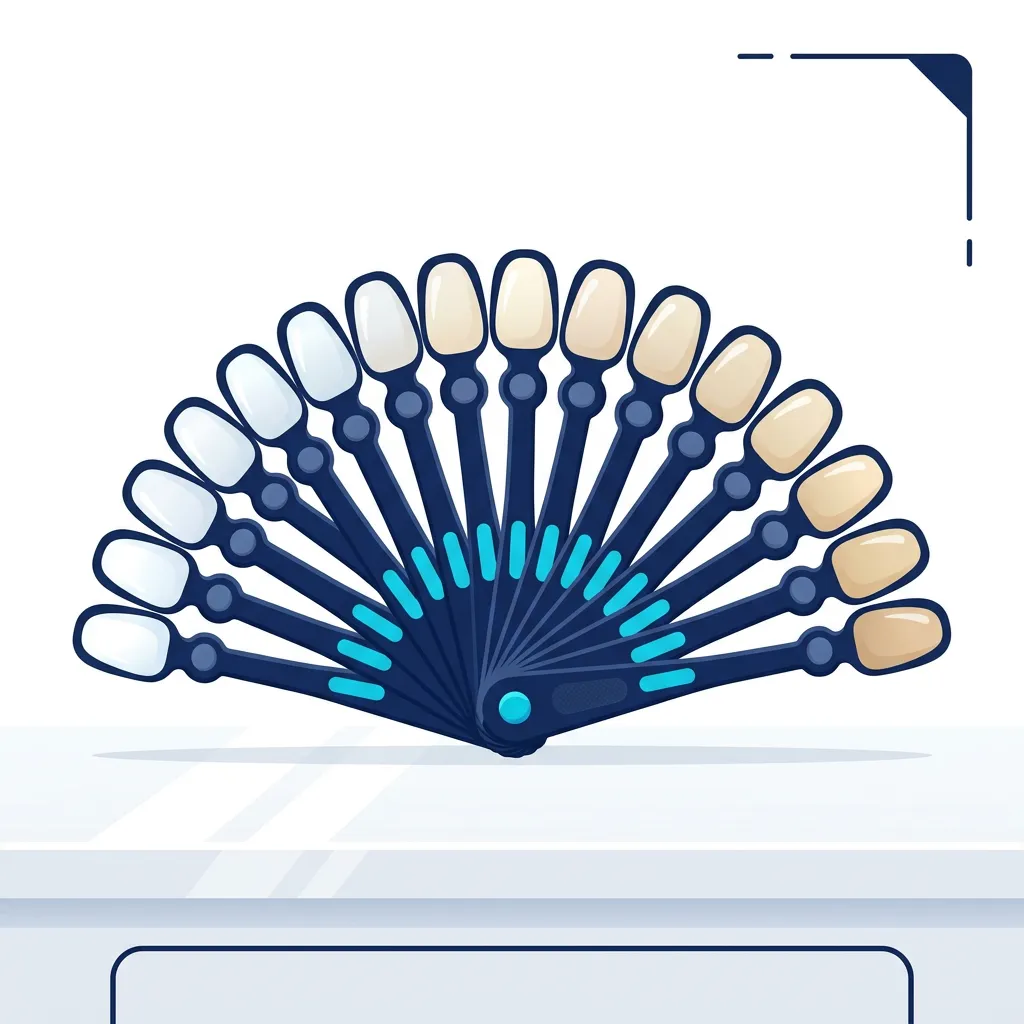
The turkey teeth colour chart is the Vita shade system, running from A1 to D4 for natural tooth colours plus BL1 to BL4 for bleach shades. Most natural adult teeth sit around A2 to A3; most veneer patients choose somewhere between B1 and BL3.
How Does the Vita Shade Chart Work?
The Vita classical shade guide organises tooth colour into four hue families: A for reddish-brown, B for reddish-yellow, C for grey, and D for reddish-grey. The number that follows shows depth of colour, so A1 is the lightest A shade and A4 the darkest.
Bleach shades were added later, once whitening and ceramics made teeth possible that nature never issued. They run BL4 to BL1, with BL1 the brightest white the chart offers.
Your dentist holds these tabs against your teeth in neutral light to record where you start and agree where you finish. The conversation matters more than the tab: two people choosing BL2 can want it for completely different reasons.
You may also see the Vita 3D-Master system quoted, which grades teeth by lightness first rather than hue family. Most Turkish clinics still talk in classical shades and bleach shades, so this guide sticks to the labels you will actually hear in the chair.
| Shade | Where it sits | How it reads in person |
|---|---|---|
| BL1 | Brightest bleach shade | Flat, chalky white; unmistakably done |
| BL2 | Classic "Hollywood" white | Very bright; works on screen, bold in daylight |
| BL3 | Softest popular bleach shade | Bright but plausible; the usual recommendation |
| BL4 | Gentlest bleach shade | A whitened-but-real look |
| B1 | Brightest naturally occurring shade | The lightest colour real teeth reach |
| A1 | Light natural | Fresh, believable, quietly white |
| A2-A3 | Average adult range | Where most untreated smiles live |
Guess which shade daylight punishes most?
Why Does BL1 Photograph Oddly in Daylight?
BL1 looks different in photographs because it reflects light almost uniformly, where natural enamel absorbs and scatters some of it. Under a camera flash that uniformity reads as dazzling. In flat daylight it reads as chalk.
Natural teeth are brighter at the biting edge, warmer at the gum, and slightly translucent throughout. BL1 at full opacity deletes all three signals at once, which is why the eye flags it as manufactured even when each individual tooth is beautifully made.
There is a simple benchmark hiding in every face: the whites of your eyes. Teeth noticeably brighter than your sclera look edited, in person and in pictures. It is also why spotting over-white work in gone-wrong pictures is so easy once you know what to look for.
Know which white suits your face?
How Do You Choose the Right Shade for Your Face?
Shade choice starts with three references: the whites of your eyes, your skin tone, and how much tooth your smile actually shows. A shade that flatters one combination can overwhelm another.
Deeper and warmer skin tones create more contrast, so brighter shades like BL2 and BL3 sit comfortably. Very fair skin offers less contrast, and the same BL2 can dominate the whole face. Age belongs in the equation too, because a 55-year-old with BL1 teeth creates a mismatch every observer notices without being able to name.
The practical method beats theory: try the tabs against your face in daylight, photograph them, and look at the pictures the next day. Shade selection is a designed decision at the clinic, part of designing a natural turkey teeth result rather than a box ticked in the chair.
What Makes a Shade Look Natural Rather Than Done?
Natural-looking teeth vary within themselves, so the goal is a believable gradient rather than one flat colour. Good ceramic work builds in a slightly translucent biting edge, gentle warmth near the gum, and surface texture that catches light the way enamel does.
The material carries half of this. Layered E-max transmits light like enamel, while cheaper monolithic work in bright shades produces the bathroom-tile effect, and how the material turkey teeth are made of affects colour explains that link between ceramic and shade in full.
Thickness matters too. Very thin veneers borrow some colour from the tooth beneath, which is useful information if those teeth are dark, and what teeth look like under veneers, and what shows through covers when that helps and when it fights the shade you chose.
Curious what everyone else picks?
Which Shades Do Most UK Patients Actually Choose?
BL3 and BL2 take the majority of full-set cases at the clinic, with B1 the favourite for patients matching veneers to their own untreated teeth. BL1 requests have fallen year on year, usually surviving no further than the daylight photo test.
The pattern behind the numbers: patients arrive asking for the brightest shade and leave choosing one or two steps below it. Nobody has ever come back asking us to make their veneers whiter than their face can carry. Several have paid twice to come back the other way.
As a rule of thumb, choose the shade you love, then look hard at the one below it. The regret risk runs in only one direction.
Reading More Before You Choose
Shade is one decision inside a larger design, and full-set makeovers raise the stakes because there are no natural teeth left on show to anchor the colour. That is why the Hollywood smile in Turkey shade conversation covers how 16 to 20 units change the maths, and why the biggest smiles need the most restraint.
Frequently Asked Questions
-
What is the most popular shade for turkey teeth?
BL3 is the most requested shade at the clinic in Antalya, bright enough to look transformed but soft enough to survive daylight. BL2 follows for patients who want an unmistakable Hollywood finish, and B1 leads whenever veneers need to match untouched natural teeth alongside them.
-
Can you change the shade after veneers are fitted?
No. Ceramic holds its colour permanently, which is the good news and the bad news: whitening gel does nothing to porcelain, so the only route to a different shade is replacing the veneers. That is why we slow the shade decision down rather than speed it up.
-
Is BL1 always a mistake?
Not always, but nearly. BL1 can work on stage, on screen and on very high-contrast faces that show little gum. For most people it photographs as flat white and reads as artificial in person, which is why we usually steer to BL2 or BL3 and show the daylight comparison first.
-
What shade looks natural for someone over 40?
B1 to A1 reads as naturally excellent teeth on an over-40 face, and BL4 passes as carefully whitened. Teeth darken gradually with age, so the further a chosen shade sits from that expectation, the more visibly restored the result looks. Brightening by two or three steps flatters; jumping six announces itself.
-
Do veneer shades look different in photos than in person?
Yes, consistently. Flash and phone filters push whites brighter and flatten texture, so veneers look one to two shades lighter on screen than across a table. Judge your shade in daylight and in unedited photos before you approve it, because that is where the next ten years happen.