
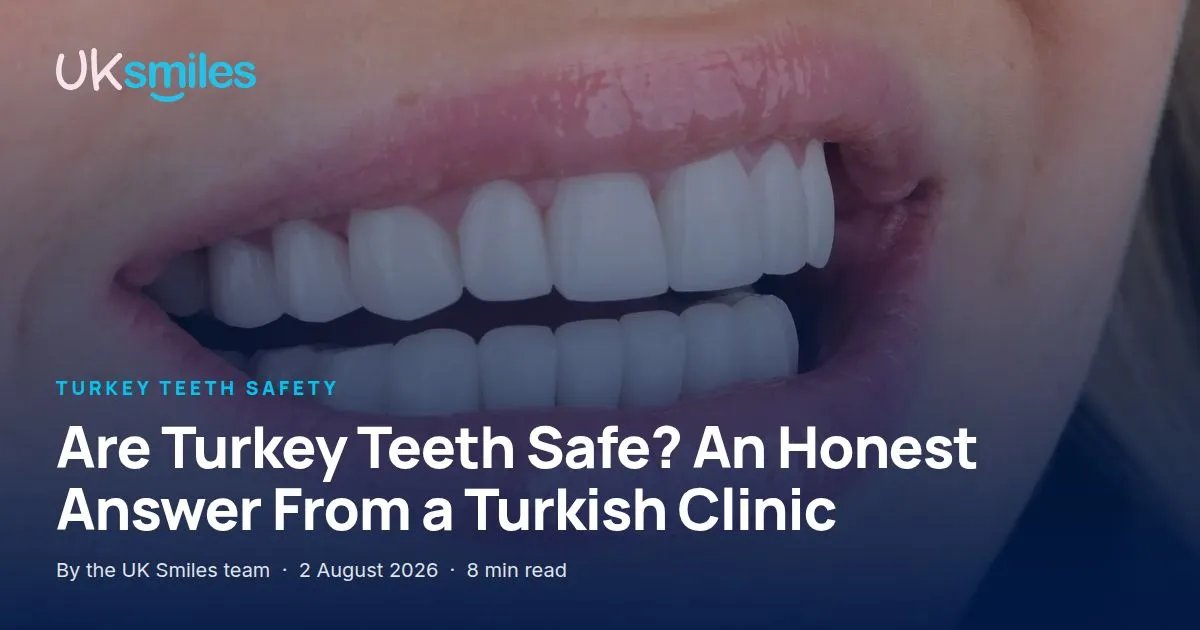
Are Turkey Teeth Safe? An Honest Answer From a Turkish Clinic
Turkey teeth are safe when a licensed, dentist-led clinic plans them around your dental health, and unsafe when a sales team plans them around a package price. The country decides the cost. The clinic decides the risk.
That is not the answer either side of this argument wants to give you. UK dentists earn from telling you to stay home, and Turkish clinics earn from telling you everything is fine. We are a Turkish clinic, so read what follows with that in mind, and check every claim yourself.
Why Is "It Depends on the Clinic" the Honest Answer?
"It depends on the clinic" is the honest answer because the evidence points both ways at once. Thousands of UK patients are treated in Turkey without incident every year, and UK dentists genuinely do see a steady stream of failed work from a specific type of clinic.
The scale is real. In the General Dental Council survey of 2,415 UK adults in January 2024, 6% had received dental care outside the UK in the previous year, and among 18 to 34 year olds the figure was 18% [1]. Cost was the most common reason.
If dental treatment abroad were reliably dangerous, numbers like that would produce failures in every street in Britain. They don't. What UK dentists actually report is a pattern: the failures cluster around rushed, price-led treatment, and we have written up what actually happens when turkey teeth go wrong in detail.
One more honest note before the checklists: no clinic can make the risk zero, ours included. What a good clinic does is remove every avoidable risk and stay reachable for whatever remains.
So the question worth asking is not "is Turkey safe". It is "what separates the clinics that produce good work from the ones that produce the horror stories". That has a concrete answer.
So what does the safe version look like?
What Makes Turkey Teeth Safe?
Safe turkey teeth come from six things: a dentist-led assessment, the right treatment for your mouth, named materials, a realistic timeline, verifiable licensing and a real aftercare pathway. Remove any one of them and the risk starts climbing.
- Assessment before quote. X-rays or a CT scan reviewed by a named dentist, gum health checked, existing problems treated first. A final price before imaging is guesswork with a payment link.
- The right treatment, not the biggest. An honest plan sometimes says six veneers, or bonding, or nothing yet. Twenty crowns as the default answer is a business model, not dentistry.
- Materials with names. You should be told the exact system going in your mouth and be able to look it up. We explain the materials turkey teeth are made of, brand by brand, so quotes stop being vague.
- A timeline biology can meet. Proper lab work, a trial smile you sleep on, and time to adjust the bite. Five to seven days for veneers or crowns is realistic. Three is a corner being cut.
- Licensing you can verify. Ministry of Health registration and a named, registered dentist are the legal baseline, not a bonus feature.
- Aftercare that survives the flight home. A named contact, scheduled photo reviews and a written guarantee. Good all-inclusive turkey teeth packages build the review appointments into the plan rather than leaving you to chase a WhatsApp number.
None of this is exotic. It is what any careful private dentist does anywhere, and it is the checklist our own safe turkey teeth treatment is built around. Safety in Turkey means refusing to let the holiday format strip those steps out.
Notice what is missing from that list: the country. Every item can be done well or badly in London, Budapest or Antalya. The failure stories come from clinics that dropped the steps, and the price war is what tempts them to drop the steps.
What Makes Turkey Teeth Unsafe?
Unsafe turkey teeth come from the same commercial pattern every time: a price quoted before an X-ray, a full set of crowns as the default, a three-day schedule and nobody to call afterwards. Each shortcut compounds the next.
The clinical damage starts with over-drilling. Full crowns require far more tooth removal than laminate veneers, and healthy young teeth cut down for a cheap full set carry that loss forever. We cover how much enamel is removed for turkey teeth with real figures, because this is the number that decides most long-term outcomes.
Speed does the rest. Gum disease left untreated under new crowns keeps smouldering.
A bite fitted in a hurry chips porcelain within months. An infection that would be caught at a two-week review instead surfaces as an abscess in Britain, with the treating dentist 2,000 miles away.
Picture the version we get asked to repair: a 28-year-old with healthy teeth crowned down for a bargain full set, gums bleeding at month two, a front crown chipped by month eight, and the clinic replying with a discount code for a repair trip. Nothing in that sequence was bad luck.
Price is the reliable tell. Materials, lab technicians and dentist time have real costs in Turkey too, so a quote 40% below the middle of the market has removed one of them. You just can't see which one until later.
Wondering what to ask before you book?
What Questions Should You Ask Before Booking?
Eight questions separate serious clinics from sales operations faster than any review page. Ask them by email rather than phone, because written answers are considered answers, and the ones you keep are the ones that count later.
- Which named dentist will plan and carry out my treatment, and where are they registered?
- Will you review my X-rays or CT scan before confirming the price?
- Why this treatment? What would you do if I asked for the most conservative option instead?
- Exactly which material and brand will be used, and which lab makes the restorations?
- How many days does my plan need, and what happens on each?
- What does your guarantee cover in writing, and what voids it?
- Who do I contact in month three if something feels wrong, and what is the process?
- What would make you refuse to treat me?
The last question is the quiet killer. A clinic with no refusal criteria has no clinical standards, only a sales pipeline. Ours include untreated gum disease, unrealistic expectations and requests to crown healthy teeth that need lighter treatment.
Curious how the two systems really compare?
How Do Turkish and UK Dental Standards Actually Compare?
Turkish dentists train for five years at university and practise under Ministry of Health licensing, the same broad structure as most of Europe. Equipment in the bigger Turkish clinics is often newer than in an average UK practice, because treatment volumes fund it.
The honest differences sit elsewhere. UK patients are protected by the General Dental Council's complaints system, and by having their dentist ten minutes away for the next decade. Treatment in Turkey trades that proximity for price, which is exactly why the aftercare pathway and written guarantee matter so much more.
There is a paperwork difference too. A complaint about a UK dentist goes to a regulator with power to act.
A complaint about a Turkish clinic goes through Turkish channels, in Turkish, at distance. Realistic patients plan for that by choosing clinics that never let things get that far.
And Turkey's price advantage has a side effect nobody markets: it attracts a segment of clinics that compete on price alone. The regulation is the same for them. The incentives are not.
Regulation sets the floor a clinic must clear, and how that licensing system works is worth ten minutes of your research time.
Reading On Before You Decide
Licensing, inspection marks and dentist registration are the checkable half of clinic safety, and most badges on clinic homepages tell you less than they appear to. We explain how Turkish dental clinic accreditation works layer by layer: Ministry of Health permits, dental association membership, international certificates, and how to verify each one yourself.
Frequently Asked Questions
-
Are Turkish dentists properly qualified?
Yes. Turkish dentists complete a five-year university dentistry degree and must be licensed under the Ministry of Health to practise. Qualification is not the weak point in dental tourism. Treatment planning, timelines and follow-up are where good and bad clinics separate, so screen for those instead.
-
Is it safe to have a full set of crowns done in a week?
A full set can be completed safely in five to seven days when gums are healthy and planning is done before you fly. What is not safe is compressing assessment, preparation, lab work and fitting into three days, or crowning teeth that only needed veneers or bonding.
-
How do I check a Turkish clinic is licensed?
Ask for the clinic's Ministry of Health licence details and the treating dentist's full name and registration, then verify rather than taking screenshots on trust. A legitimate clinic hands these over without friction. Hesitation, excuses or "our reviews speak for themselves" answers your question a different way.
-
Why is treatment in Turkey so much cheaper?
Lower wages, lower rents, a favourable exchange rate and higher patient volumes. Those are real economics, not a quality discount, and they explain most of the gap with UK private prices. The suspicious gap is the one below Turkey's own market rate, which usually means corners being cut.
-
Is it safe to fly home straight after treatment?
After veneers or crowns, yes, flying is no problem once fitting is complete. After implant surgery or extractions, clinics normally advise waiting a couple of days before flying, which is why properly planned trips build recovery time in rather than booking the earliest possible return.
References
- [1] General Dental Council - Views and experiences of dentistry, survey of 2,415 UK adults (January 2024), figures on dental treatment abroad - gdc-uk.org - accessed July 2026.