

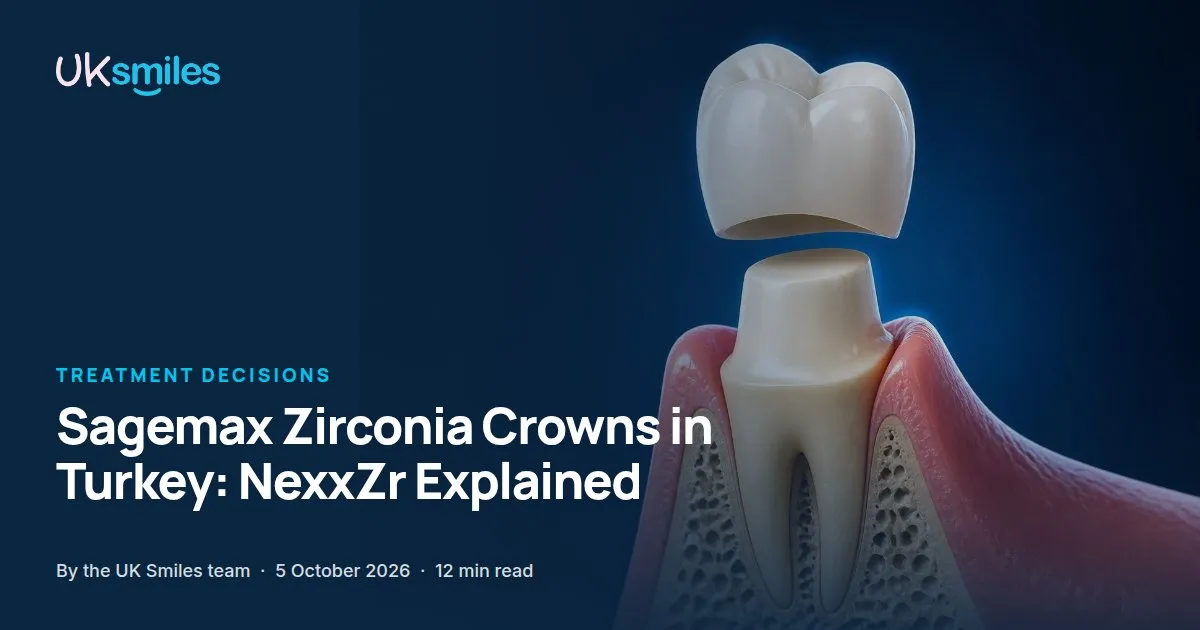
Sagemax Zirconia Crowns in Turkey: What NexxZr Is and Why People Choose It
Sagemax is an American zirconia maker, part of the Ivoclar group, and NexxZr is its family of zirconia materials for crowns and bridges. Its multilayer versions change in shade and translucency from the gum to the biting edge, so crowns look more like natural teeth while keeping zirconia's strength where you bite.
What Is Sagemax?
Sagemax Bioceramics is a specialist zirconia manufacturer founded in 2006. The company says its materials are developed and produced in Federal Way, Washington, in the USA.
In 2017 it was bought by Ivoclar, the Liechtenstein company behind IPS e.max, one of the best-known names in cosmetic dentistry. Sagemax kept its own brand and still focuses on zirconia for dental laboratories.
You will never see a Sagemax product in a box at the dentist. It arrives at the laboratory as a solid disc, and a technician mills your crowns out of it with a computer-guided machine, then fires, stains and glazes them.
So when a treatment plan says "Sagemax", it is naming the raw material your crowns are cut from. That matters more than it sounds, because the disc decides how strong the crown is and how much light passes through it. For prices and the full treatment, see our guide to zirconia and Emax crowns in Turkey.
So what exactly is NexxZr?
What Is NexxZr, and Which Types Are There?
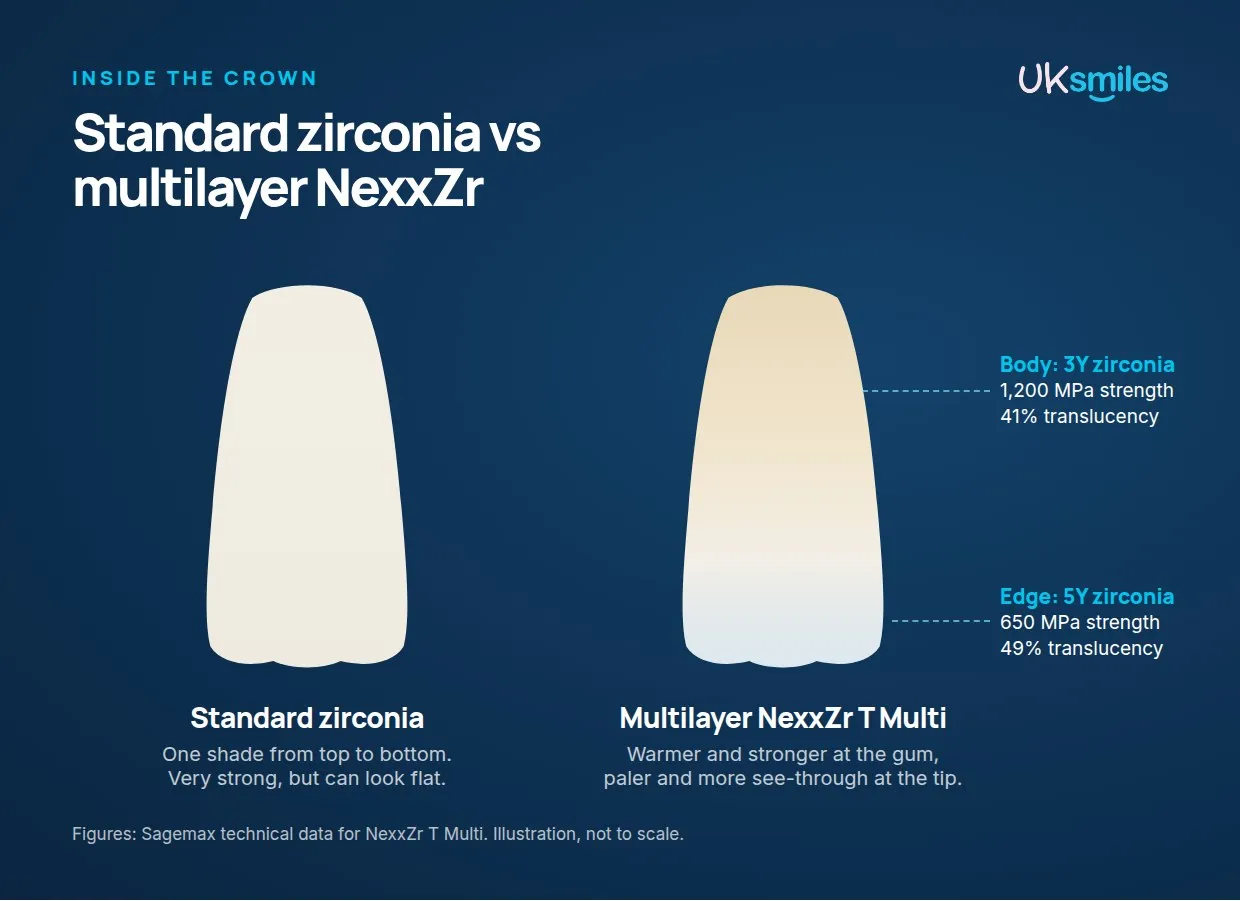
NexxZr is the name of Sagemax's zirconia range. There are four main versions, and they trade a little strength for a little more translucency as you move down the list.
| NexxZr type | Build | Strength (manufacturer) | Translucency (manufacturer) | Made for |
|---|---|---|---|---|
| NexxZr T | Single shade | 1,270 MPa | 42% | Single crowns up to multi-unit bridges |
| NexxZr T Multi | Multilayer gradient | 1,200 MPa body, 650 MPa edge | 41% body, 49% edge | Single crowns up to multi-unit bridges |
| NexxZr+ | Single shade, high translucency | 880 to 1,000 MPa | 46% | Front and back crowns |
| NexxZr+ Multi | Multilayer gradient | 850 MPa body, 650 MPa edge | 45% body, 49% edge | Single crowns and 3-unit bridges |
The strength figures are flexural strength, a laboratory test of how much bending force a sample takes before it breaks. For comparison, glass ceramics such as Emax sit well below these figures, which is why zirconia is trusted for back teeth and bridges.
The "T" versions are the tougher ones. The "+" versions are tuned for looks, with a little more light passing through.
If the codes 3Y, 4Y and 5Y ever appear on a lab note, they describe the recipe. More yttria in the mix makes zirconia more translucent but less strong, so 3Y is the strongest and 5Y the most see-through.
Why would you want two recipes in one crown?
How Does Multilayer Zirconia Copy a Real Tooth?
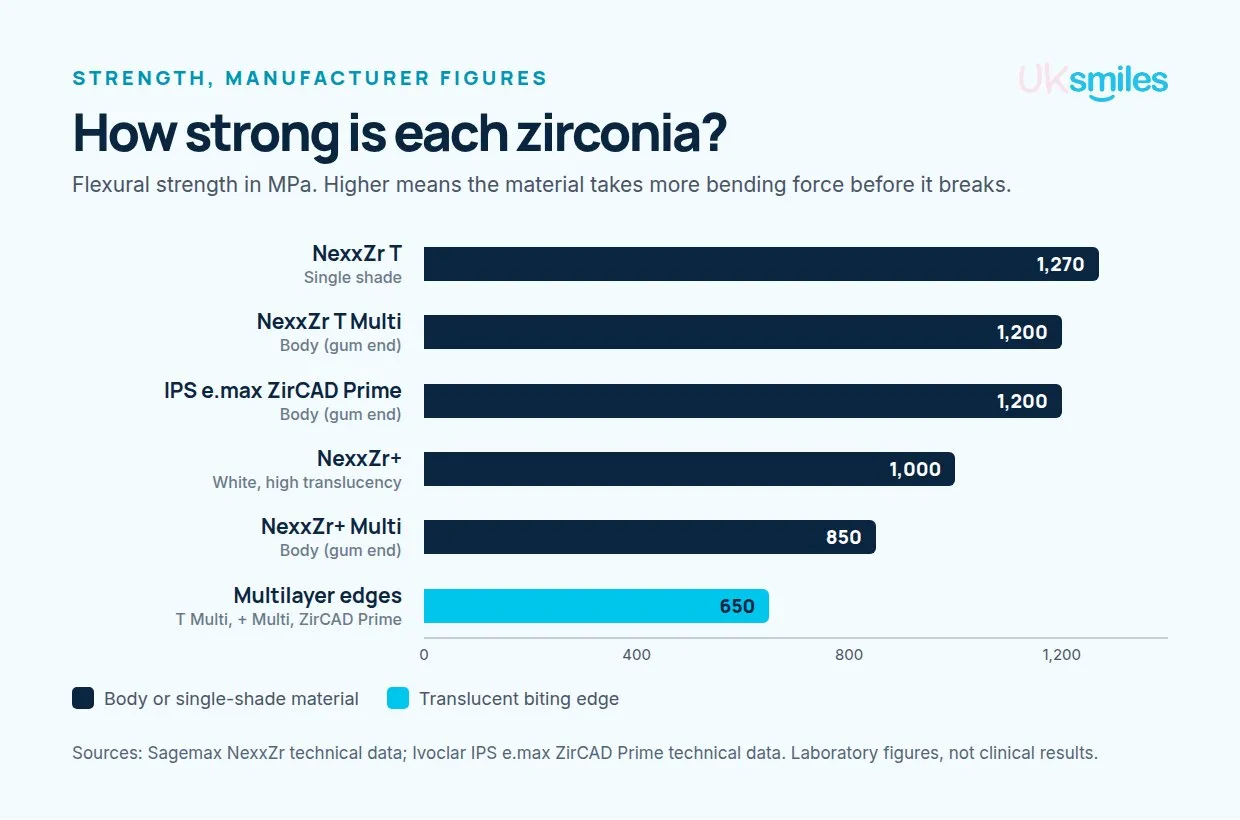
Look closely at a natural front tooth and it is not one colour. It is warmer and more solid near the gum, and the biting edge is paler and slightly see-through.
Older zirconia was a single block of one shade. It was incredibly strong but could look flat and chalky, which is part of why some crowns from years ago look obviously fake.
Multilayer NexxZr fixes that inside the disc itself. Sagemax describes a smooth gradient of colour and translucency, with the strong, more opaque material at the gum end and the more translucent material at the tip.
In NexxZr T Multi, the body of the disc uses the strongest 3Y recipe and the edge uses the more translucent 5Y recipe. The technician positions each crown in the disc so the layers land in the right place on your tooth.
The result is a crown that does more of the "natural tooth" work on its own, before any staining or glazing.
Why Do People Choose Sagemax Crowns in Turkey?
Most people who ask for Sagemax have one thing in mind: they want crowns that are strong enough to last but do not look like crowns.
- A more lifelike finish. The built-in shade and translucency shift avoids the flat, one-colour look of basic zirconia.
- Strength where you bite. The body of the crown keeps zirconia-level strength, which suits back teeth, bridges and people who grind.
- No metal. With no metal core there is no grey line waiting to appear at the gum, the classic problem we explain in our guide to why some crowns show a black line at the gum.
- Less to chip. Crowns can be milled as one solid piece of zirconia, with no separate porcelain layer on top to flake off.
- A name you can check. Sagemax is a known manufacturer within the Ivoclar group, so you can look the material up yourself rather than trusting a vague "premium zirconia" line.
- Works across a full smile. The T versions are made for single crowns through to multi-unit bridges, so one material can cover front and back teeth in a matching shade.
That last point is a big one for full sets. If you are planning a whole smile of premium zirconium crowns in Turkey, keeping one material across every tooth makes it much easier to get an even, natural shade from side to side.
But does the research back it up?
What Does the Research Say About Zirconia Crowns?
There are no long-term clinical trials on Sagemax crowns specifically, so be wary of anyone who quotes one. What there is, is a good body of research on zirconia crowns in general, and it tells a clear story.
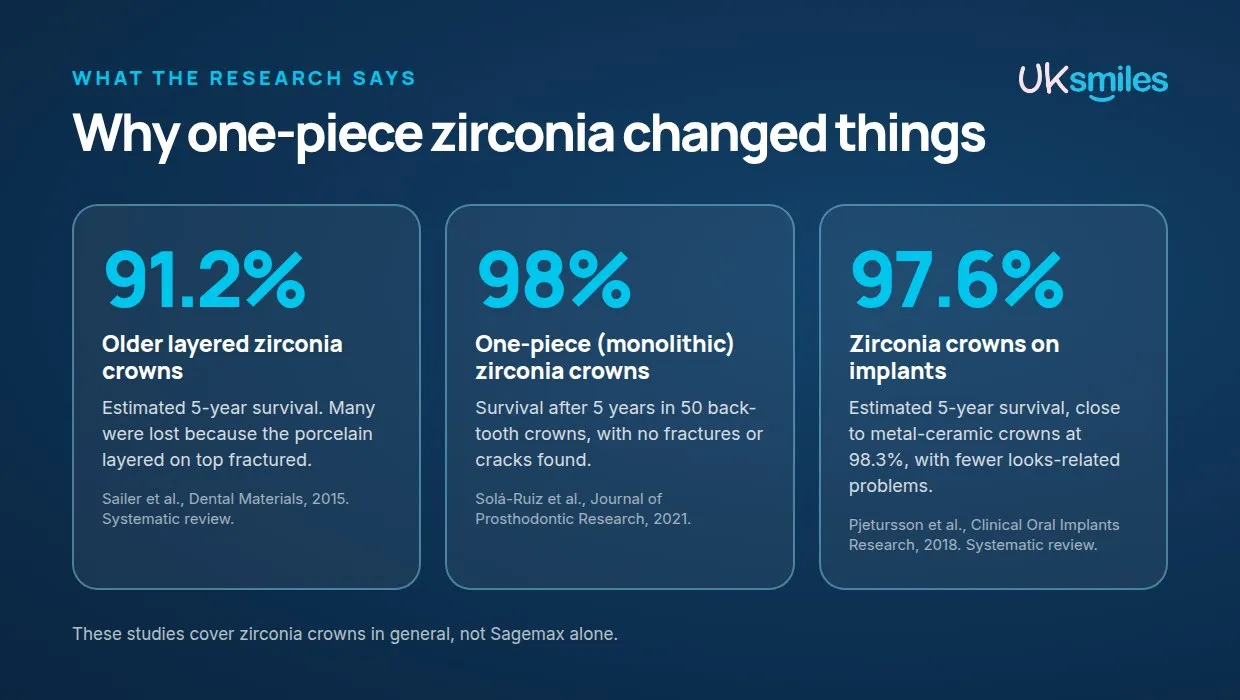
Older layered zirconia had a chipping problem. A 2015 systematic review in Dental Materials put the estimated five-year survival of zirconia single crowns at 91.2%, compared with 95.7% for metal-ceramic crowns. Zirconia crowns were lost more often because the porcelain layered over them fractured, and the authors advised against them as a first choice at the time.
One-piece zirconia fixed most of that. Modern crowns are increasingly milled as a single solid piece, with no porcelain layer to chip. In a 2021 study of 50 one-piece zirconia crowns on back teeth, 98% survived five years, and no fractures or cracks were found.
It holds up on implants too. A 2018 systematic review of crowns on implants estimated five-year survival at 97.6% for zirconia and 98.3% for metal-ceramic, with almost identical chipping rates and fewer looks-related problems with zirconia. The same review did find more zirconia crowns failing from fractures of the material itself, which is one reason the strong body of a multilayer crown matters.
Your other teeth matter as well. A 2019 review of clinical studies found that one-piece zirconia caused wear on the opposing teeth similar to, or a little more than, natural teeth, but less than metal-ceramic crowns.
Multilayer materials like NexxZr are built on that lesson: keep the crown in one piece, keep the strongest zirconia where it takes the load, and put the translucent material only where it shows.
So is there any catch at all?
Are There Any Downsides to Sagemax Zirconia?
There are a few, and a good clinic will tell you about them up front.
- It costs more. Premium multilayer zirconia is an upgrade on standard zirconia, so it adds to the price of each crown.
- It is still a crown. The tooth underneath has to be shaped on every side to make room. The material does not change that, so it is worth understanding the difference between crowns and veneers in Turkey before you choose.
- The edge is the softer part. The translucent tip of a multilayer disc is listed at 650 MPa, about half the strength of the body. It is still strong, but your dentist may suggest a stronger single-shade option, and a night guard, if you grind heavily.
- It is not as see-through as Emax. For thin veneers on front teeth, glass ceramic still gives the most enamel-like glow.
- The lab still matters. A great disc in the hands of a rushed technician will not give a great result. Shade choice, staining and glazing all show.
Sagemax vs Standard Zirconia, ZirCAD Prime and Emax
Here is how Sagemax multilayer zirconia sits next to the other materials you are likely to see on a quote.
| Material | What it is | Looks | Best for |
|---|---|---|---|
| Standard zirconia | Single-shade zirconia | Strong but can look flatter | Back teeth, budget full sets |
| Sagemax NexxZr Multi | Multilayer zirconia, Sagemax (Ivoclar group) | Natural gradient from gum to tip | Smile-zone crowns, full sets, bridges |
| IPS e.max ZirCAD Prime | Gradient zirconia, Ivoclar | Natural gradient with no visible layers | Crowns and bridges, including long bridges |
| Emax (lithium disilicate) | Glass ceramic, Ivoclar | Most enamel-like | Veneers and front crowns |
Sagemax NexxZr and ZirCAD Prime are close cousins. Both blend a strong 3Y body with a translucent 5Y edge, and Ivoclar lists ZirCAD Prime at 1,200 MPa in the body and 650 MPa at the edge, the same headline numbers as NexxZr T Multi.
The real choice is usually between premium zirconia and Emax. If you are mainly fixing the look of healthy front teeth, Emax laminate veneers keep more of your natural tooth. If teeth are heavily filled, broken or missing, crowns in a premium zirconia make more sense.
For a wider view of every option, our guide to the materials used for Turkey teeth covers Emax, zirconia, porcelain fused to metal and composite side by side.
Who Is Sagemax Zirconia Best For?
Sagemax multilayer zirconia tends to suit people who:
- Need crowns rather than veneers, because teeth are worn, broken, heavily filled or root filled.
- Are having crowns on the teeth that show when they smile and want them to look natural.
- Want one material across a full set of upper and lower crowns.
- Are replacing old crowns that look flat, chalky or show a dark line at the gum.
- Need bridges or teeth on implants, such as All-on-4 implant bridges, where strength over several teeth matters.
It is less of a fit if you only need a couple of back crowns that nobody will see. Standard zirconia does that job well for less.
How do you know you are actually getting it?
How to Check You Are Getting Genuine Sagemax
"Premium zirconia" on a quote can mean almost anything. These questions settle it.
- Ask for the brand and the product. Not just "Sagemax", but which NexxZr, for example NexxZr T Multi, written on your treatment plan.
- Ask which teeth get which material. Some plans mix premium zirconia at the front with standard zirconia at the back. That can be sensible, but you should know.
- Ask who mills the crowns. A clinic using a named material will happily tell you which laboratory makes your teeth.
- Agree your shade properly. Our guide to Turkey teeth shades explains the shade guide, so you can pick a colour that suits your face rather than the brightest one on the chart.
How Are Sagemax Crowns Made?
Every clinic works a little differently, but premium zirconia crowns typically go through the same stages.
- Consultation and shade. Your dentist checks your teeth and gums, takes X-rays and agrees the shape and shade with you.
- Preparation. Each tooth is gently shaped so the crown can sit over it, and you wear temporary teeth in the meantime.
- Digital design. Your teeth are scanned, and a technician designs each crown on screen to fit your bite.
- Milling. The crowns are cut from the Sagemax disc, positioned so the stronger body and the translucent edge land in the right places.
- Sintering. The crowns are fired in a furnace, where they shrink slightly and reach full strength.
- Staining and glazing. The technician adds fine colour detail and a final glaze or polish.
- Try-in and fitting. You see the crowns in your mouth before they are cemented, so the shape and shade can be checked first.
How Do You Look After Zirconia Crowns?
Zirconia itself does not decay, but the tooth underneath and the gum around it still can. Most problems with crowns start at the edge where crown meets tooth.
- Brush twice a day with a soft brush and fluoride toothpaste, paying attention to the gum line.
- Clean between your teeth every day with interdental brushes or floss, especially around bridges.
- Wear a night guard if you grind. It protects your crowns and the teeth they bite against.
- Do not use your teeth as tools. Opening packets or cracking nuts is how even strong crowns get damaged.
- Keep up regular check-ups with a dentist at home, so any gum or bite changes are caught early.
Getting Sagemax Crowns in Turkey With UK Smiles
At UK Smiles, Sagemax NexxZr is available as a premium upgrade to standard zirconia, alongside Ivoclar's IPS e.max ZirCAD Prime. Your patient coordinator and dentist will talk you through both and show you the difference before you decide.
The upgrade price depends on how many crowns you are having, so ask your patient coordinator for the figure for your own treatment plan. For a wider picture of prices, see what turkey teeth cost in 2026.
There is nothing to pay up front, so you can book with complete peace of mind. All you need to do is book your flights and fill in our booking form, and we'll sort the rest.
Wondering how long your new crowns will last? Our guide to how long Turkey crowns last covers the habits and check-ups that make the biggest difference.
Frequently Asked Questions
-
Is Sagemax zirconia good for crowns?
Yes. Sagemax is a specialist zirconia manufacturer, founded in 2006 and part of the Ivoclar group since 2017, and its NexxZr materials are made for crowns and bridges. The multilayer versions are popular for smile-zone crowns because they shift in shade and translucency from the gum to the biting edge, like a natural tooth.
-
Is Sagemax the same as Emax?
No. Both now sit within the Ivoclar group, but they are different materials. Sagemax NexxZr is zirconia, a very strong ceramic used mainly for crowns and bridges. IPS e.max is lithium disilicate, a glass ceramic best known for thin veneers and front crowns.
-
How strong is Sagemax zirconia?
It depends on the product. Sagemax lists NexxZr T at 1,270 MPa, and the strong lower layer of NexxZr T Multi at 1,200 MPa. The more translucent biting edge of its multilayer discs is listed at 650 MPa. These are the manufacturer's own laboratory figures.
-
Do Sagemax crowns look natural?
Multilayer NexxZr is designed to. The colour and translucency change gradually through the disc, so a crown is more opaque near the gum and more translucent towards the tip. How natural the finished crown looks also depends on the shade chosen and the skill of the technician who stains and glazes it.
-
Can Sagemax crowns be whitened?
No. Like all ceramic crowns, zirconia does not respond to whitening gel. If you want whiter natural teeth around your crowns, whiten them first and match the crown shade afterwards.
-
Do zirconia crowns wear down the teeth they bite against?
A 2019 systematic review of clinical studies found that wear on the opposing teeth from one-piece zirconia crowns was similar to or a little more than natural teeth cause, but less than metal-ceramic crowns. A well-polished surface matters, so ask for the crowns to be polished and checked after any bite adjustment.
-
Where is Sagemax zirconia made?
Sagemax develops and produces its materials in Federal Way, Washington, in the USA.
Sources
- Sagemax, NexxZr zirconia portfolio, technical data for NexxZr T, T Multi, + and + Multi.
- Sagemax, NexxZr T Multi, layer composition and indications.
- Sagemax, Company, founding year and production in Federal Way, Washington.
- Dental Products Report, Ivoclar Vivadent acquires Sagemax Bioceramics, September 2017.
- Ivoclar, IPS e.max ZirCAD Prime, technical data.
- Sailer I, Makarov NA, Thoma DS, Zwahlen M, Pjetursson BE. All-ceramic or metal-ceramic tooth-supported fixed dental prostheses? A systematic review of the survival and complication rates. Part I: Single crowns. Dental Materials, 2015.
- Solá-Ruiz MF, Baixauli-López M, Roig-Vanaclocha A, Amengual-Lorenzo J, Agustín-Panadero R. Prospective study of monolithic zirconia crowns: clinical behavior and survival rate at a 5-year follow-up. Journal of Prosthodontic Research, 2021.
- Pjetursson BE, Valente NA, Strasding M, Zwahlen M, Liu S, Sailer I. A systematic review of the survival and complication rates of zirconia-ceramic and metal-ceramic single crowns. Clinical Oral Implants Research, 2018.
- Gou M, Chen H, Kang J, Wang H. Antagonist enamel wear of tooth-supported monolithic zirconia posterior crowns in vivo: A systematic review. The Journal of Prosthetic Dentistry, 2019.