
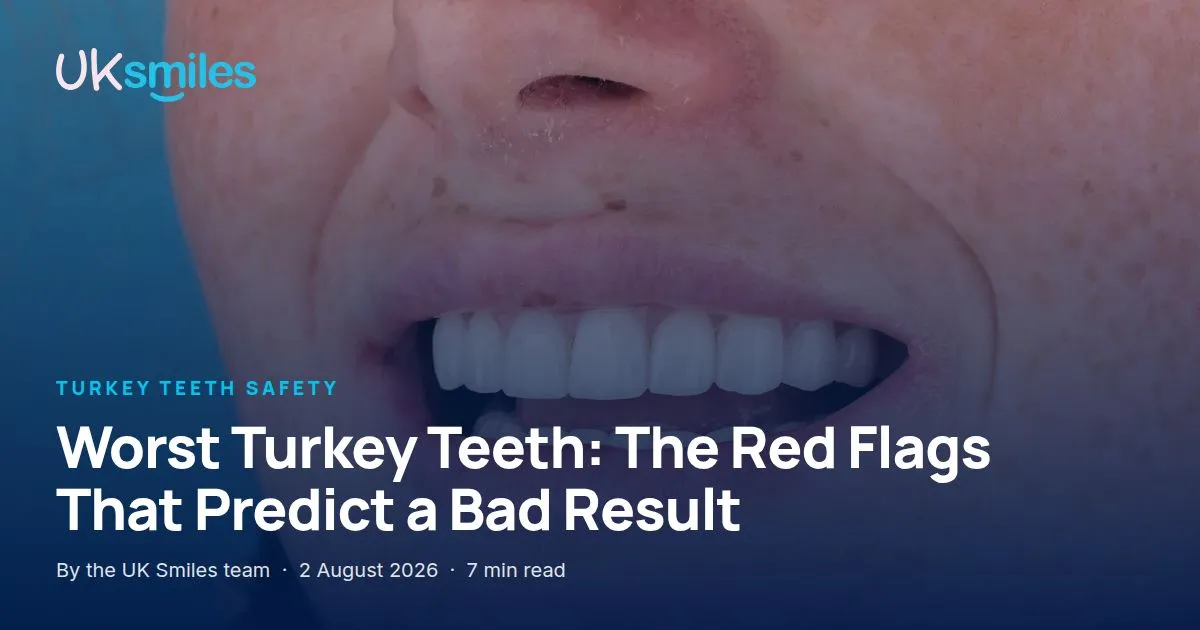
Worst Turkey Teeth: The Red Flags That Predict a Bad Result
The worst turkey teeth results are predictable, because they follow the same red flags: same-day full sets, prices that undercut the whole market, no dentist-led consultation, pressure selling, anonymous clinicians, stock-photo results and no aftercare plan.
People search "worst turkey teeth" to see disasters. More useful is knowing that the disasters were visible in advance, in the emails and quotes those patients received weeks before flying. This guide turns the wreckage into a screening checklist.
What Are the 7 Red Flags That Predict the Worst Turkey Teeth?
The 7 red flags that predict the worst turkey teeth are a compressed schedule, a rock-bottom price, a quote without imaging, pressure selling, no named dentist, unverifiable results and no aftercare plan. Any one deserves questions. Two or more deserve a different clinic.
- 1. The whole smile in two or three days. Biology needs longer, so something you needed gets skipped.
- 2. A price far below every competitor. The missing money came out of materials, lab work or planning time.
- 3. A final quote before any X-ray. Nobody can plan your mouth from a phone selfie.
- 4. Deposit-today discounts and countdown pressure. Clinical confidence does not need urgency tactics.
- 5. No named, checkable dentist. "Our expert team" is not a person you can verify.
- 6. Results you can't trace to real patients. Stock photos and suspiciously perfect reviews.
- 7. Nothing in writing about aftercare. Problems surface at month three, when the sales chat has gone quiet.
The rest of this guide takes the flags in order and explains the economics underneath each one, because understanding why a corner gets cut is what makes the flag stick in your memory.
Which flag matters most, then?
Why Is a Two or Three Day Full Set the Biggest Red Flag?
A full set of crowns or veneers compressed into two or three days is the biggest red flag because the timetable itself removes safety steps. Gum treatment, root canal work flagged by scans, proper lab time and a trial smile all take days the schedule does not have.
A realistic veneer or crown trip runs five to seven days: consultation and imaging, preparation, a temporary or trial phase you sleep on, then fitting and bite adjustment. Clinics selling three-day sets have decided in advance that your scans will show nothing worth treating. That is not a prediction anyone can honestly make.
Try the subtraction yourself. Take the five-to-seven day plan above and remove enough to fit a long weekend.
Whatever you crossed out first, the gum treatment, the lab time, the trial night, the clinic crossed out too. It just did not mention it in the brochure.
What Does a Rock-Bottom Price Actually Remove?
A rock-bottom quote removes something real, because dentist time, ceramic materials and lab technicians have hard costs in Turkey too. Cheap sets are usually cheap through bulk generic ceramics, in-house rush lab work, or junior clinicians working to volume targets.
Turkey's genuine saving comes from lower wages, lower rents and a weaker lira, and it is already built into every honest quote. A clinic undercutting that honest level by another 40% is not a better negotiator. It is spending less on your mouth and hoping you can't tell from a brochure.
You can test this politely. Ask which lab makes the restorations, which material brand is being quoted, and whether the price changes if your scans show root canal work is needed. Vague answers to all three tell you where the discount came from.
The bitter joke in this industry is that the cheapest set often becomes the most expensive one, once you add the cost of putting it right. The savings evaporate in one repair trip.
So what does a proper consultation involve?
What Should a Real Consultation Look Like?
A real consultation reviews your X-rays or CT scan, examines your gums, discusses more than one treatment option and is led by a dentist whose full name you know. It sometimes ends with advice to do less, or to treat disease first, or not to fly at all.
The worst results almost never start that way. They start with a price list, a WhatsApp reply inside four minutes, and a "patient coordinator" whose job title means salesperson.
If you cannot name the dentist who will hold the drill, you have not had a consultation. You have had a pitch.
A real consultation also runs the other way: the clinic asks about you. Medical history, medication, grinding habits, what you dislike about your current teeth, what you expect afterwards.
A clinic that asks nothing is not planning treatment. It is processing an order.
Pressure is the same signal in different clothing. Expiring discounts, "only two slots left this month", a deposit request on the first call. A clinic confident in its clinical work lets you take two weeks to think, because it knows the comparison flatters it.
Trust the before-and-after photos, do you?
How Do You Check a Clinic's Results Are Real?
Real results survive three checks: reverse-image searching the photos, matching results to named or video patients, and looking for consistent lighting and gum healing rather than airbrushed uniformity. Stolen and stock smile photos fail the first check surprisingly often.
Reviews need the same scepticism, because five-star profiles can be manufactured in an afternoon. Bursts of reviews in the same week, identical phrasing across accounts and reviewers with one lifetime review are the usual tells. We wrote a full guide on how to spot fake dental clinic reviews, including the checks we invite on our own.
Then ask for one more thing: a case like yours. Same starting problem, similar number of teeth, healed photos at review stage.
Clinics doing careful volume have them ready. Clinics doing templates have twenty identical white sets and nothing in between.
Shade is the subtler tell in result photos. Whole galleries of identical fridge-white rectangles suggest one shade sold to every face, which is design laziness you would wear for a decade. For contrast, see how white turkey teeth should actually be when someone designs for a face rather than a feed.
Why Does "No Aftercare Plan" Guarantee the Worst Outcomes?
Missing aftercare turns small problems into disasters, because the first months are when trouble surfaces: a high bite spot, gum inflammation at a crown margin, sensitivity that isn't settling. Caught at a review, each is a small fix. Ignored, each compounds.
On paper, a real aftercare plan is specific: a review schedule with dates, photo check-ins, a named person who answers, and a guarantee stating what is covered, for how long, and what voids it. A "lifetime guarantee" homepage badge with none of that underneath is decoration.
This is the flag that separates the merely cheap from the genuinely dangerous. A clinic can cut lab costs and still produce wearable teeth. A clinic with no review system, no photo check-ins and no named contact has no way of knowing its own failure rate, and no reason to care.
The catalogue of the ways turkey teeth go wrong is largely a catalogue of problems nobody was watching for.
It is also the easiest flag to test before booking. Email a shortlisted clinic and ask exactly what happens at month three if something feels wrong. Time the reply, and read whether it names a process or just reassures you.
What Does the Opposite Look Like?
The opposite of the worst turkey teeth is boring, and that is the point. Imaging reviewed before a final quote, a named dentist, a schedule with slack in it, materials you can look up, a written guarantee and diarised reviews after you fly home.
Boring is worth paying for in dentistry. Every dramatic story in this article started as an exciting offer, and every uneventful ten-year smile started as a slightly tedious planning process.
Put any clinic, including ours, against the seven flags before you pay a deposit. That is what a properly planned turkey teeth treatment looks like from the inside, and a clinic that resents the scrutiny has answered your real question already.
Before You Shortlist Anyone
Credentials are the natural next check once a clinic passes the seven flags. Ministry of Health licensing, dental association membership and international marks like JCI each verify something different, and homepage badges mean nothing without certificate numbers you can check. Here is which clinic accreditations actually mean something, and how to confirm each one.